
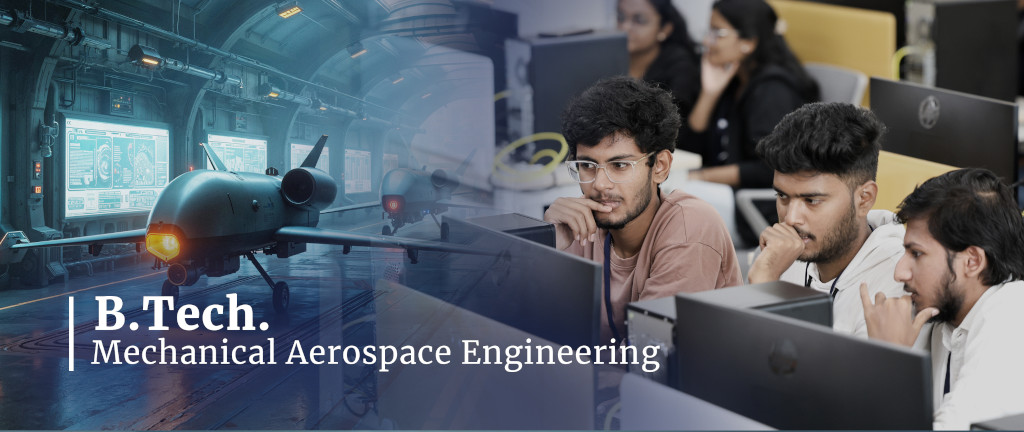
The B.Tech. in Mechanical & Aerospace Engineering is designed for students seeking to understand and build complex engineering systems that operate on the ground, in the air, and beyond. The programme combines strong foundations in mechanics, thermodynamics, fluid dynamics, materials engineering, manufacturing, and systems design with specialized aerospace applications including aerodynamics, propulsion, structures, and spacecraft systems.
Students may pursue focused pathways in Aero Fluid & Thermal Engineering, Aerospace Structures & Manufacturing, and Aircraft & Spacecraft Systems, enabling them to explore domains ranging from advanced propulsion and aerodynamics to spacecraft design and intelligent manufacturing. Through simulation-driven learning, experimental validation, and multidisciplinary projects, students gain the ability to transform engineering concepts into real-world systems.
Eligibility Criteria
- Minimum of 65% in Mathematics, Physics, and Chemistry (individually).
- At least 60% aggregate in PUC/12th or an equivalent examination from a recognized board.
- Valid score in JEE, KCET, COMEDK or any other state entrance exam.
Chanakya Edge
- Strong foundation in mechanics, thermodynamics, fluid dynamics, materials engineering, manufacturing, aerodynamics, and aerospace systems.
- Specialized pathways in Aero Fluid & Thermal Engineering, Aerospace Structures & Manufacturing, and Aircraft & Spacecraft Systems.
- Extensive use of industry-standard tools including Ansys for simulation and 3DEXPERIENCE for design, analysis, and product lifecycle management.
- Limited memory-based assessments, with evaluation focused on engineering design challenges, simulation studies, experimental investigations, and capstone projects.
- Hands-on learning through wind tunnel experimentation, manufacturing processes, rapid prototyping, and system-level engineering projects.
- Opportunities to participate in flagship student-driven initiatives such as Formula Bharat, ChanakyaSAT, Electric Vehicle, and Drone Development programmes.
- Access to modern infrastructure including the Wind Tunnel & Dynamics Lab, Manufacturing Lab, Makers Space, High Performance Computing facility, and Ground Station.
- Strong interdisciplinary integration with Artificial Intelligence, Robotics, Sustainable Mobility, Space Systems, and Advanced Manufacturing technologies.

Programme Highlights
- PEO1: Graduates will establish themselves as professionals by applying foundational and advanced knowledge in mechanical and aerospace systems to design, analyse and manufacture efficient, safe and innovative engineering solutions.
- PEO2: Graduates will promote and implement sustainable, energy-efficient and climate-conscious practices in the development of mechanical and aerospace technologies with consideration of societal, economic and environmental impacts.
- PEO3: Graduates will continuously enhance their knowledge and technical skills through advanced education, research or professional development, particularly in emerging areas such as robotics, autonomous systems, propulsion and computational modelling.
- PEO4: Graduates will demonstrate leadership, ethical responsibility and effective communication while working in interdisciplinary teams and managing projects that address complex engineering challenges in aerospace and mechanical domains.
Programme Structure
S. No. | Category | Credits |
1 | Basic Science Courses | 18 |
2 | Engineering Science Courses | 09 |
3 | Professional Core Courses | 48 |
4 | Professional Electives | 24 |
5 | Humanities & Social Sciences Core | 06 |
6 | Humanities & Social Sciences Elective | 06 |
7 | Open Electives | 17 |
8 | Project Work & Internship | 12 |
9 | Non-Credit Mandatory Courses | 00 |
10 | Flexible Credits | 20 |
TOTAL CREDITS | 160 | |
Collaborations
Simple Energy
- Battery technology development
IN-SPACe
- Professional workshops
- Deployment of Earth Observation payload
Bullwork Mobility
- Development of autonomous electric vehicle systems
GalaxEye
- Radar Research Lab
- Earth observation and advanced sensing technologies
EDS Technologies
- Training and usage of 3DEXPERIENCE design and simulation platform
Cadmaxx Solutions
- CAD, engineering design, and industry-focused technical training
These collaborations provide opportunities for internships, workshops, project mentorship, and exposure to real-world challenges in aerospace systems, advanced manufacturing, sustainable mobility, simulation-driven design, and space technologies.