
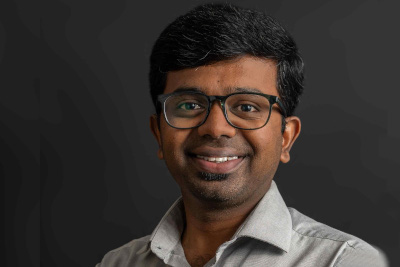
Pradeep B Keshavanarayana
Ph.D., University of Glasgow, UKPradeep B Keshavanarayana
Ph.D., University of Glasgow, UKMy research focuses on understanding how physical forces regulate biological responses in health and disease. Biological tissues are living systems where mechanical cues and fluid dynamics are intimately linked to cellular signalling, barrier integrity, and metabolic function. Our goal is to decipher how disruptions to this delicate biophysical balance drive vascular breakdown, tissue swelling, and progressive cellular degeneration.
A major focus of our laboratory is ocular disease biology, with a particular emphasis on retinal transport and microvascular complications. In conditions such as diabetic retinopathy and diabetic macular oedema (DME), breakdown of the blood–retinal barrier leads to abnormal vascular leakage and fluid accumulation. We build computational models to investigate how specialised retinal cells, including Müller glia and the retinal pigment epithelium (RPE), coordinate fluid clearance and regulate local mechanical stresses during oedema. By simulating these processes across cellular and tissue scales, we aim to understand why patients respond heterogeneously to standard anti-VEGF therapies and how glial-vascular remodelling influences disease outcomes.
Beyond the retina, we investigate the mechanobiology of the tumour microenvironment, specifically interrogating cancer–extracellular matrix (ECM) interactions. During malignant progression, abnormal matrix stiffening, dense collagen remodelling, and compromised lymphatic drainage lead to elevated interstitial fluid pressure and altered solid stress. These mechanical abnormalities act as physical barriers that hinder drug perfusion while simultaneously triggering mechanotransducive signalling cascades that stimulate cancer cell invasion, epithelial-to-mesenchymal transition (EMT), and angiogenic sprouting.
To interrogate these complex biological phenomena, we use a spectrum of multi-scale computational techniques, including the Finite Element Method (FEM), agent-based modelling (ABM), and Scientific Machine Learning (SciML) approaches such as Physics-Informed Neural Networks (PINNs). These complementary computational frameworks allow us to non-invasively estimate patient-specific tissue properties, track microscopic drug diffusion, and build predictive “digital twins” of diseased microenvironments. Collaboration across disciplines is at the core of our approach. We actively partner with experimental biologists, clinicians, and imaging experts to ground our predictive models in direct biological observation.
Dr. Pradeep B Keshavanarayana is an Assistant Professor in the School of Biosciences at Chanakya University. His research lies at the convergence of computational biomechanics, soft tissue mechanics, mechanobiology, and scientific machine learning, with a central focus on ocular transport, microvascular dynamics, and tumour–extracellular matrix interactions.
Prior to joining Chanakya University, Dr. Pradeep was a Research Fellow at University College London (UCL) within the Centre for computational medicine. Before this, he worked as a research fellow at the school of maths at University of Birmingham, UK. His postdoctoral training includes developing multiscale mathematical models on endothelial junction mechanics, vascular permeability, and fluid transport. Additionally, he previously led the structural dynamics team as a Space Structures Engineer at Agnikul Cosmos (IIT Madras).
Dr. Pradeep earned his Ph.D. in cell mechanics and biomechanical engineering from the University of Glasgow, UK, where he designed custom mechanobiology platforms and computational finite element frameworks to probe cellular contractility.
Dr. Pradeep has been awarded the UCL Impact Fellowship (2025-2026). He has disseminated his research internationally, including presentations at the Association for Research in Vision and Ophthalmology (ARVO), supported by competitive grants such as the Macular Society Travel Award, and at the UK Parliament. He has published in leading international journals such as Nature Cell Biology, Biophysical Journal and International Journal of Solids and Structures. He serves as an academic reviewer for several international journals.
- Doctor of Philosophy: University of Glasgow, UK
- MSc: University of Stuttgart, Germany
- BTech: NITK Surathkal, India
Journal publications
- P.Keshavanarayana*, E. Brown, P. Luthert, R. Shipley, S. Walker-Samuel. Mechanisms of macular oedema development and therapeutic response: An in-silico modelling study. 2026. Under review – Investigative Ophthalmology and Visual Sciences. bioRxiv:10.64898/2026.02.17.706117.
- Soheil Sarbishei, Yousef Javanmardi, Reza Azarbad, Morteza Naeij, Pradeep Keshavanarayana, Emad Moeendarbary, Fabian Spill. A continuous-discrete model of cell contraction incorporating actin and intermediate filaments. Iscience, 2026.
- S.Rawal, P.Keshavanarayana, P.Khuntia, D.Manoj, S.Banerjee, B. Thurakkal, R.Marwaha, F.Spill, and T.Das. Edge curvature drives endoplasmic reticulum reorganization and dictates epithelial migration mode. Nature Cell Biology, 2025. doi:10.1038/s41556-025-01729-3.
- M.Botticelli, J. Metzcar, T. Phillips, S. Cox, P.Keshavanarayana*, F.Spill. A hybrid computational model of cancer spheroid growth with ribose-induced collagen stiffening. Frontiers in Bioengineering and Biotechnology, 2025, vol 13, pages 1515962. doi: 10.3389/fbioe.2025.1515962.
- P.Keshavanarayana, R.A.Yuste, F.Spill, MJ.Gomez-Benito, and E.Bastounis. Leveraging computational modeling to explore epithelial and endothelial cell monolayer mechanobiology. Trends in Cell Biology, 2025, vol 35(9), pages 799-813. doi: 10.1016/j.tcb.2024.12.014.
- P.Keshavanarayana, F. Spill, A mechanical modelling framework to study endothelial permeability, Biophysical Journal, 2024, vol 123(3), pages 334-348. 10.1016/j.bpj.2023.12.026.
- P.Keshavanarayana*, M.Ruess, R.de Borst. On the monolithic and staggered solution of cell contractility and focal adhesion growth, International Journal for Numerical Methods in Biomedical Engineering, 2018, vol 34(11), pages e3138. doi: 10.1002/cnm.3138.
- P.Keshavanarayana*, M.Ruess, R.de Borst. A feedback-loop extended stress fiber growth model with focal adhesion formation, International Journal of Solids and Structures, 2017, vol 128, pages 160-173. doi: 10.1016/j.ijsolstr.2017.08.023.
Conference publications
- P.Keshavanarayana, S. Walker-Samuel, Patient-specific retinal geometry and vasculature distribution dictate the spatiotemporal progression of macular oedema. IOVS, 2025.
- P.Keshavanarayana, Y.Javanmardi, E.Moeendarbary, F.Spill. Effect of physical and geometrical stimuli on microvascular dynamics. Biophysical Journal, 2023.
- P.Keshavanarayana, M.Ruess. R. de Borst. A coupled stress-fiber focal-adhesion model for cell contractility, ECCM-ECFD, Glasgow, UK, 2018.
- P.Keshavanarayana, R.de Borst, M. Ruess. A monolithic approach to cell contractility. Association for Computational Mechanics in Engineering, Cardiff, UK, 2016.
Presentations
Conference talks
- A combination of mechanical stimuli dictates the temporal behaviour of vasculature permeability, Society for Mathematical Biology, Edmonton, Canada, 2025.
- Using physics-informed deep generative learning to model blood flow in the retina, Society for Mathematical Biology, Edmonton, Canada, 2025.
- Patient-specific retinal geometry and vasculature distribution dictate the spatiotemporal progression of macular oedema, ARVO, Salt Lake City, 2025.
- Mechano-chemical regulation of endothelial permeability – an in-silico study, SMB, Seoul. 2024.
- Role of endothelium in cancer extravasation – An in-silico study, ICCB, Vienna, 2023.
- Mathematical model for the dynamics of the endothelium; British Applied Mathematics Colloquium, Bristol, 2023
- A coupled stress-fibre focal-adhesion model for cell contractility; ECCM-ECFD, Glasgow, 2018.
- A monolithic approach to cell contractility; UK-Applied Computational Mechanics Conference, Cardiff, 2016.
- Analysis of the influence of substrate properties and focal adhesion formation on the stress fibre growth and reorientation in contractile cells; ICBME, Singapore, 2016.
Poster presentations
- How mechanical forces affect the permeability of endothelium, GRC Vascular Biology, Boston, USA, 2023
- Endothelial cells playing a tug of war; EMBL, Barcelona, 2022
- Mathematically modelling the dynamics of cell-cell junctions: Implications on the biology of spread of diseases; STEM for Britain finalist, UK Parliament, 2022
- Numerical and experimental investigations of cell reorientation, University of Glasgow, 2018.
- Numerical computation of stress fibre orientation, Cell Mech, Windermere UK, 2017.