
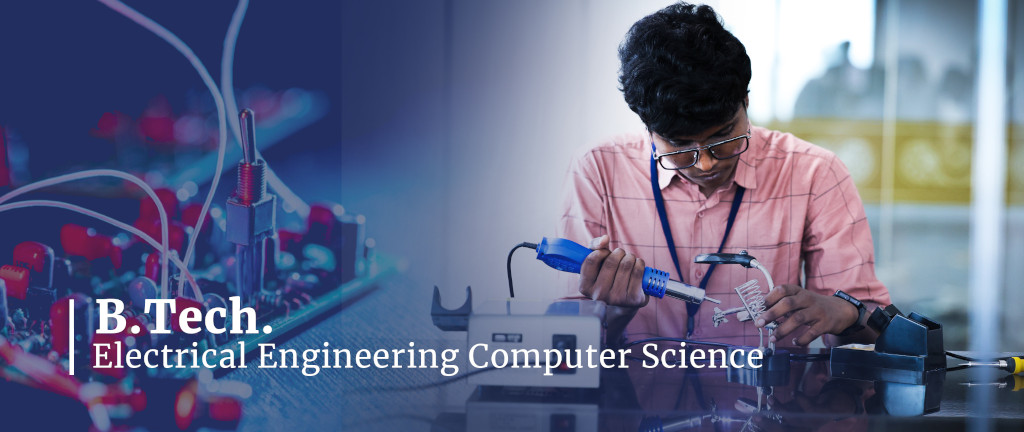
The B.Tech. in Electrical Engineering & Computer Science is an interdisciplinary programme that combines the foundations of electrical engineering with the computational capabilities required to build modern intelligent systems. Students develop expertise in electrical circuits, power systems, embedded systems, signal processing, control engineering, and computer science while learning to design, analyze, and manage complex cyber-physical systems.
The programme offers focused pathways in Sustainable Power & Energy Systems, covering renewable energy, smart grids, energy storage, and electric mobility, and Control & Automation of Industrial Systems, covering industrial automation, robotics, embedded intelligence, and advanced control systems. Through hands-on experimentation, industry-integrated learning, and multidisciplinary projects, students gain the skills required to contribute to the future of energy, mobility, automation, and intelligent infrastructure.
Eligibility Criteria
- Minimum of 65% in Mathematics, Physics, and Chemistry (individually).
- At least 60% aggregate in PUC/12th or an equivalent examination from a recognized board.
- Valid score in JEE, KCET, COMEDK or any other state entrance exam.
Chanakya Edge
- Strong foundation in electrical engineering, computer science, embedded systems, control engineering, power electronics, and signal processing.
- Specialized pathways in Sustainable Power & Energy Systems and Control & Automation of Industrial Systems.
- Curriculum includes emerging domains such as renewable energy integration, smart grids, electric vehicle technology, robotics, embedded machine learning, industrial automation, and cybersecurity for cyber-physical systems.
- Limited memory-based assessments, with evaluation focused on system design, hardware-software integration, automation challenges, and engineering projects.
- Hands-on learning through embedded systems development, sensor integration, power electronics laboratories, control system implementation, and real-world engineering applications.
- Exposure to industry-relevant technologies including PLC/SCADA systems, FPGA-based design, energy storage systems, electric drives, and intelligent automation platforms.
- Opportunities to participate in student-driven projects such as the Electric Vehicle, ChanakyaSAT, and Robotics initiatives, enabling students to apply classroom learning to real engineering challenges.
- Strong interdisciplinary integration with Artificial Intelligence, Robotics, Space Systems, Sustainable Mobility, and Semiconductor Technologies.

Programme Highlights
- PEO1: Graduates will apply electrical engineering and computing fundamentals to solve engineering problems in industry, research and society.
- PEO2: Graduates will contribute to power, energy, automation, robotics, embedded systems and allied technology sectors.
- PEO3: Graduates will pursue higher studies, research, entrepreneurship or professional leadership with ethical and sustainable practice.
Programme Structure
S. No. | Category | Credits |
1 | Basic Science Courses | 18 |
2 | Engineering Science Courses | 09 |
3 | Professional Core Courses | 48 |
4 | Professional Electives | 24 |
5 | Humanities & Social Sciences Core | 06 |
6 | Humanities & Social Sciences Elective | 06 |
7 | Open Electives | 17 |
8 | Project Work & Internship | 12 |
9 | Non-Credit Mandatory Courses | 00 |
10 | Flexible Credits | 20 |
TOTAL CREDITS | 160 | |
Collaborations
Pure Storage
- Establishment of Centre of Excellence
- Development of flash memory storage devices
Simple Energy
- Battery technology development
GalaxEye
- Radar Research Lab
IN-SPACe
- Professional workshops
- Deployment of Earth Observation payload
Bullwork Mobility
- Development of autonomous electric vehicle systems
These collaborations provide opportunities for internships, project mentorship, workshops, and exposure to real-world challenges in energy systems, embedded technologies, mobility, and space applications.