
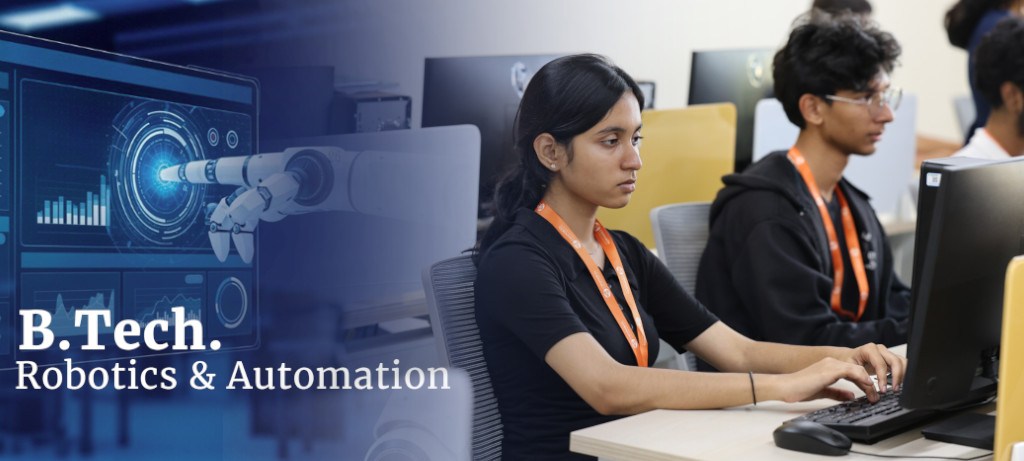
The B.Tech. in Robotics & Automation prepares students to design, build, and deploy intelligent machines capable of sensing, decision-making, and autonomous operation. The programme integrates mechanical systems, electronics, control engineering, embedded computing, artificial intelligence, and software development to create a strong foundation in modern robotics and automation technologies.
Students may pursue specialized pathways in Robotics Engineering, focusing on mobile robots, drones, autonomous systems, and intelligent machines; Control & Automation, covering industrial automation, sensor integration, embedded control systems, and real-time computing; and Tools & Software for Robotics, emphasizing simulation, digital twins, robot operating systems, and autonomous navigation. Through project-based learning and multidisciplinary engineering experiences, students develop the skills required to contribute to next-generation manufacturing, mobility, aerospace, logistics, healthcare, and defence systems.
Eligibility Criteria
- Minimum of 65% in Mathematics, Physics, and Chemistry (individually).
- At least 60% aggregate in PUC/12th or an equivalent examination from a recognized board.
- Valid score in JEE, KCET, COMEDK or any other state entrance exam.
Chanakya Edge / Highlights
- Strong foundation in robotics, mechatronics, control systems, embedded systems, machine vision, artificial intelligence, and autonomous systems.
- Specialized pathways in Robotics Engineering, Control & Automation, and Robotics Software & Simulation.
- Curriculum includes emerging domains such as Robot Operating System (ROS), digital twins, autonomous navigation, sensor fusion, embedded AI, computer vision, and intelligent automation.
- Limited memory-based assessments, with evaluation focused on system integration challenges, robot design projects, autonomous navigation tasks, and engineering capstone projects.
- Hands-on learning through robotics platforms, embedded controllers, simulation environments, rapid prototyping, and real-world automation projects.
- Opportunities to participate in student-driven initiatives including Drone Development, Electric Vehicle systems, Formula Bharat, and intelligent mobility projects.
- Access to industry-standard tools including 3DEXPERIENCE, MATLAB, Ansys, and advanced simulation platforms supporting robotics design and validation.
- Strong interdisciplinary integration with Artificial Intelligence, Mechanical Engineering, Electronics, Space Systems, and Sustainable Mobility.

Programme Objectives
- PEO1: Graduates will establish themselves as competent engineers in robotics, automation, embedded systems, manufacturing automation, robotic software and allied engineering domains.
- PEO2: Graduates will apply mechanical, electrical, electronics, control, computing and AI foundations to design safe, reliable and efficient robotic and automated systems.
- PEO3: Graduates will pursue higher education, research, certifications, entrepreneurship or professional growth in emerging areas such as autonomous systems, Industry 4.0, smart manufacturing, robot perception, edge AI and digital twins.
- PEO4: Graduates will work responsibly in interdisciplinary teams while considering safety, ethics, sustainability, human-machine collaboration and societal impact.
Credit Structure
S. No. | Category | Credits |
1 | Basic Science Courses | 18 |
2 | Engineering Science Courses | 09 |
3 | Professional Core Courses | 48 |
4 | Professional Electives | 24 |
5 | Humanities & Social Sciences Core | 06 |
6 | Humanities & Social Sciences Elective | 06 |
7 | Open Electives | 17 |
8 | Project Work & Internship | 12 |
9 | Non-Credit Mandatory Courses | 00 |
10 | Flexible Credits | 20 |
TOTAL CREDITS | 160 | |
Collaborations & Partnerships
EDS Technologies
- Training and usage of 3DEXPERIENCE design and simulation platform
Cadmaxx Solutions
- CAD and engineering design solutions
Bullwork Mobility
- Development of autonomous electric vehicle systems
These collaborations provide opportunities for internships, workshops, project mentorship, and exposure to real-world challenges in intelligent automation, robotics design, digital engineering, and autonomous mobility systems.
Career Opportunities
- PSO1: Apply principles of mechanics, electronics, control, sensing, actuation and computing to design and analyse robotic mechanisms and automation systems.
- PSO2: Develop embedded, control and automation solutions using sensors, actuators, drives, PLC/SCADA, industrial networks and AI-enabled decision-making.
- PSO3: Use modern engineering tools such as ROS, MATLAB/Simulink, Gazebo, digital twin platforms and embedded development environments to simulate, integrate, test and deploy robotic systems.