
Director’s Message
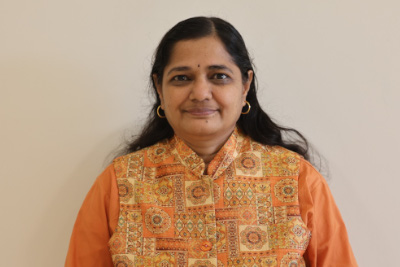
Director (Academics), School of Engineering
Shobana Padmanabhan
Engineering, at its core, is not the accumulation of formulas or the mastery of tools. It is the disciplined practice of problem-solving: understanding constraints and working with imperfect information to design solutions that function in the real world. Every programme offered by the School of Engineering is built around this central idea.
Our undergraduate and postgraduate offerings span computing, artificial intelligence, electronics, electrical systems, mechanical and aerospace engineering, civil infrastructure, robotics, geoinformatics, and advanced computing. While these domains appear diverse, they are united by a common pedagogic philosophy: learning by doing.
Students do not encounter engineering as a set of abstract theories divorced from application. From the early semesters, they work with real datasets, physical systems, software stacks, laboratory instruments, and design constraints. Whether it is writing code to analyse data, designing a chip, modelling a structure, automating a robotic system, or interpreting satellite imagery, learning is anchored in execution.
Problem-solving is treated as a method, not an outcome. Students are trained to break down complex challenges, identify trade-offs, test assumptions, iterate designs, and validate results. This approach cuts across disciplines: software engineers learn system thinking, electronics students learn computational reasoning, civil engineers work with data and simulations, and biotechnology students integrate biological insight with engineering design.
Postgraduate programmes extend this philosophy into advanced domains. M.Tech. and M.C.A. students engage with specialised tools, applied research problems, and industry-aligned projects that demand depth and rigour. The emphasis is not only on knowing what is possible, but on understanding what works and why.
Equally important is exposure. Students learn in classrooms, laboratories, field settings, studios, and project spaces while interacting with practitioners and are encouraged to think beyond silos.
We aim to graduate engineers who are not merely qualified, but capable: individuals who can think critically, adapt quickly, and apply their knowledge to real challenges across technology, infrastructure, industry, and society.
This is engineering as it should be taught: rigorous and relentlessly practical.