
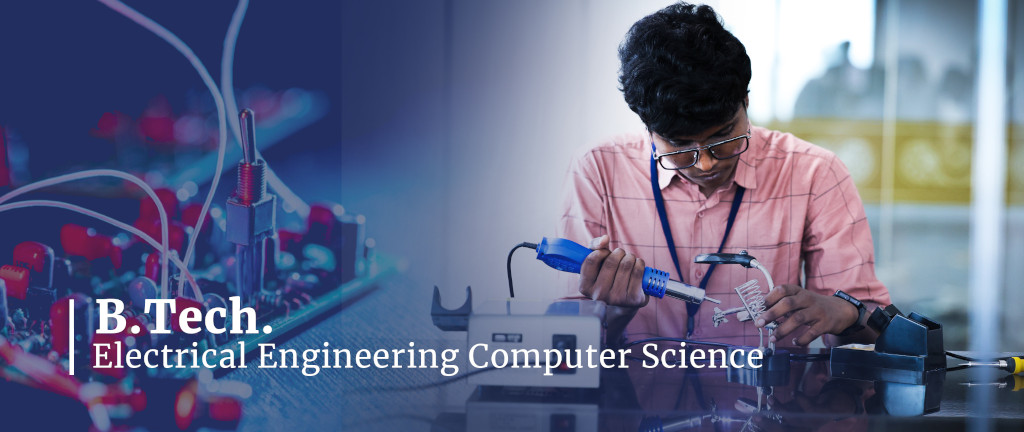
B.Tech. in Electrical Engineering & Computer Science

School of Engineering

B.Tech. in Electrical Engineering & Computer Science

The B.Tech. in Electrical Engineering & Computer Science is an interdisciplinary programme that combines the foundations of electrical engineering with the computational capabilities required to build modern intelligent systems. Students develop expertise in electrical circuits, power systems, embedded systems, signal processing, control engineering, and computer science while learning to design, analyze, and manage complex cyber-physical systems.

The programme offers focused pathways in Sustainable Power & Energy Systems, covering renewable energy, smart grids, energy storage, and electric mobility, and Control & Automation of Industrial Systems, covering industrial automation, robotics, embedded intelligence, and advanced control systems. Through hands-on experimentation, industry-integrated learning, and multidisciplinary projects, students gain the skills required to contribute to the future of energy, mobility, automation, and intelligent infrastructure.

Eligibility Criteria

  • Minimum of 65% in Mathematics, Physics, and Chemistry (individually).
  • At least 60% aggregate in PUC/12th or an equivalent examination from a recognized board.
  • Valid score in JEE, KCET, COMEDK or any other state entrance exam.
Chanakya Edge / Highlights
  • Strong foundation in electrical engineering, computer science, embedded systems, control engineering, power electronics, and signal processing.
  • Specialized pathways in Sustainable Power & Energy Systems and Control & Automation of Industrial Systems.
  • Curriculum includes emerging domains such as renewable energy integration, smart grids, electric vehicle technology, robotics, embedded machine learning, industrial automation, and cybersecurity for cyber-physical systems.
  • Limited memory-based assessments, with evaluation focused on system design, hardware-software integration, automation challenges, and engineering projects.
  • Hands-on learning through embedded systems development, sensor integration, power electronics laboratories, control system implementation, and real-world engineering applications.
  • Exposure to industry-relevant technologies including PLC/SCADA systems, FPGA-based design, energy storage systems, electric drives, and intelligent automation platforms.
  • Opportunities to participate in student-driven projects such as the Electric Vehicle, ChanakyaSAT, and Robotics initiatives, enabling students to apply classroom learning to real engineering challenges.
  • Strong interdisciplinary integration with Artificial Intelligence, Robotics, Space Systems, Sustainable Mobility, and Semiconductor Technologies.

Programme Objectives

  • PEO1: Graduates will apply electrical engineering and computing fundamentals to solve engineering problems in industry, research and society.
  • PEO2: Graduates will contribute to power, energy, automation, robotics, embedded systems and allied technology sectors.
  • PEO3: Graduates will pursue higher studies, research, entrepreneurship or professional leadership with ethical and sustainable practice.

Credit Structure

  • Year 1: Foundation in engineering sciences, mathematics, and ethics.
  • Year 2: Domain-focused courses with integrated lab work.
  • Year 3: Industry internships, electives in emerging tech, and innovation projects.
  • Year 4: Capstone projects, entrepreneurial incubation, national & global exposure.

Sno

Category

Suggested break up of credits

1

Humanities and social sciences including management courses

12

2

Basic science courses + Mathematics

18

3

Engineering science courses first year

9

4

Professional core

48

5

Professional elective

24

6

Open electives

17

7

Project work

12

8

Non Credit Mandatory courses 

Non-credit

Total

140

Course Name

Credits

Electrical Circuits and Networks

3

Computer Organization and Design

3

Data Structures and Algorithms

3

Solid State Devices

3

Microcontrollers and Embedded Systems

3

Power and Energy Engineering

3

Signals and Systems

3

Analog Systems

3

Power Electronics

3

Control Engineering

3

Operating Systems

3

Digital Signal Processing

3

Embedded Systems Design

3

Introduction to AI and ML

3

Database Management Systems

3

Introduction to Robotics

3

Collaborations & Partnerships

Pure Storage

  • Establishment of Centre of Excellence
  • Development of flash memory storage devices

Simple Energy

  • Battery technology development

GalaxEye

  • Radar Research Lab

IN-SPACe

  • Professional workshops
  • Deployment of Earth Observation payload

Bullwork Mobility

  • Development of autonomous electric vehicle systems

These collaborations provide opportunities for internships, project mentorship, workshops, and exposure to real-world challenges in energy systems, embedded technologies, mobility, and space applications.

Faculty

Shobana Padmanabhan

Director (Academics), School of Engineering

Rajesh Kumar Prasad

Associate Professor, School of Engineering

Ph.D., Indian Institute of Technology, Kanpur

Former Associate Professor & Head, Department of Mechanical Engineering, Chhatrapati Shahu Ji Maharaj University, Kanpur
Bharath Setturu

Associate Professor, School of Engineering

Ph.D., IIIT Hyderabad

Geospatial Scientist
Naresh Dixit P. S.

Assistant Professor and Convener, Institutions Innovation Council

M.Tech., VTU, Belagavi

Former Research Associate, Indian Institute of Science, Bengaluru
Vijay V.

Assistant Professor, School of Engineering

Ph.D., IIT Madras

Ashish Kumar Shukla

Assistant Professor, School of Engineering

Ph.D., IIITDM, Jabalpur

Shreehari H. S.

Assistant Professor, School of Engineering

M.S., Bremen University of Applied Sciences, Germany

Banashankari Hosur

Assistant Professor, School of Engineering

M.Tech, RVCE, Bengaluru

Former faculty of NMIT Banagalore & MCOE Pune
Banu Priya M.

Assistant Professor, School of Engineering

M. Tech., Ph.D.(Pursuing)

Bhagirathi T

Assistant Professor, School of Engineering

M.C.A, BMS College of Engineering, Bengaluru

Mulla Arshiya

Assistant Professor, School of Engineering

M.C.A., BMSCE, Bengaluru

Amogh S Raj

Assistant Professor, School of Engineering

M.Sc., Aerospace Engineering, University of Leicester

Anupam Sharma

Assistant Professor, School of Engineering

M.E., Goa University

Rachana K

Assistant professor, School of Engineering

(Ph.D.), Reva University

Sandeep Kumar

Assistant Professor, School of Engineering

Ph.D., (Thesis Submitted), Indian Institute of Technology, Delhi

Kingshuk Chatterjee

Assistant Professor, School of Engineering

Ph.D., IIT Kanpur

Sahil Bharti

Assistant Professor, School of Engineering

Ph.D., IIT Madras

Chitransh Atre

Assistant Professor, School of Engineering

Ph.D., IIT Madras

Ranjan Tiwari

Assistant Professor, School of Engineering

Ph.D., IIT Roorkee, Uttarakhand

Bhagwan Das Ahirwar

Assistant Professor, School of Engineering

M.Tech., IIT Jammu

Anjana Krishna K U

Assistant Professor, School of Engineering

M.Tech., IIT, Tirupati

Pradeep Kumar Gopalakrishnan

Professor of Practice, School of Engineering

Ph.D., Nanyang Technological University, Singapore

Ramesh Sundararaman

Professor of Practice, School of Engineering

Ph.D., Amrita Vishwa Vidyapeetham – In Progress

P. V. Venkitakrishnan

Visiting Faculty, School of Engineering

Ph.D., IIT Madras

Former Director, CBPO and Prof. Satish Dhawan Chair Scientist at ISRO
Kowshik Thopalli

Visiting Faculty, School of Engineering

Ph.D., Arizona State University

Post-doc Researcher Machine Intelligence Group, Lawrence Livermore National Laboratory
Ritesh Jain

Visiting Faculty, School of Engineering

Ph.D., University of Wuppertal, Germany Renesas Electronics

Shishir Shukla

Visiting Faculty, School of Engineering

M.S. Arizona State University Renesas Electronics

3 US patents and author of 2 IEEE publications
Siddhartha Visveswara Jayanti

Visiting Faculty, School of Engineering

Ph.D., MIT, USA

Research Scientist, Google Research
Tanujay Saha

Visiting Faculty, School of Engineering

Ph.D., Princeton University

ML Engineer, Intel Corporation, USA
Y. N. Srikant

Visiting Faculty, School of Engineering

Ph.D., Indian Institute of Science

Former Faculty, IISc Bengaluru
Sandoche Balakrichenan

Visiting Faculty, School of Engineering

Ph.D., Université Pierre et Marie Curie.

Head of Research & Development Partnerships at AFNIC, the French Network Information Center
Siddarth Rai Mahendra

Visiting Faculty, School of Engineering

Ph.D., Oregon State University

SRC, GlobalFoundries, Qorvo

Career Opportunities

  • PSO1: Engineering knowledge and problem analysis.
  • PSO2: Design and development of solutions for electrical, electronic, computational and automation systems.
  • PSO3: Investigation, modelling, simulation, experimentation and data interpretation.
  • PSO4: Use of modern engineering, computing and laboratory tools.
  • PSO5: Professional ethics, communication, teamwork, project management and lifelong learning.
  • PSO6: Awareness of sustainability, safety, societal needs and contemporary technology trends.

Join hand with us today! Extend your support to develop Global Vision.

Support Chanakya

Choose Chanakya for Learning through Experience for a Life of Excellence.

Apply as Student

Join us to lead a Culture of Learning and Leadership.

Apply as faculty