
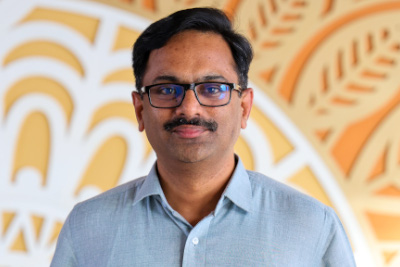
Ashwin Kumar A. P.
Ph.D., Manipal UniversityProfessor, School of Arts, Humanities and Social Sciences, and Dean, Academic Affairs, Chanakya University, Bangalore
Ashwin Kumar A. P.
Ph.D., Manipal UniversityMy research sits at the intersection of cultural studies, philosophy of language, and translation.
My current research is anchored in a programme on concept loss and predicate-level analysis of Indian languages, which I lead as Head and In-Charge of the Centre for the Study of Indian Languages (CSIL) at Chanakya University. Working with Prof. B. Narahari Rao and a wider network of scholars and technologists, I treat Indian languages not as objects of linguistic description but as repositories of learnables — registers of distinction through which generations have organised cognitive, ethical, and aesthetic life. Active strands include a project on the categories of Indian educational thought, working through mental predicates such as buddhi, manas, and indriya and their English counterparts; a semantic-analytical study of bhakti; and the design of a small language model (P-GRAM) and a domain-differentiation Un-Dictionary — together meant to give India’s conceptual heritage a working presence in contemporary research, education, and AI.
My doctoral thesis, Local Labyrinths: Language as a Problematic, took up the question of language and identity by examining how the categories we inherit from European philology and linguistics travel into Indian languages and shape what can be said and thought in them.
A second strand of my work concerns nationalism, community, and the experience of belonging. In my book Nationalism, Language and Identity in India: Measures of Community (Routledge, 2019), I argued that the dominant analytical idioms used to discuss Indian nationalism rest on doxastic assumptions about community that do not survive close examination. I am presently developing this line of inquiry further in collaborative work on de-orientalising India, including the forthcoming volume The Difficulty of Being Heathen: Essays in De-Orientalising India (co-edited with Vivek Dhareshwar, Orient Blackswan).
A third concern of mine is the future of Indian-language scholarship. Through translation work in Kannada, the Regional Language Resources Initiative, and projects such as Digital Archives in Indian Languages, I have tried to build infrastructure that allows serious philosophical and social-science work to live in Indian languages. I treat translation not as a derivative activity but as a primary site of conceptual labour.
Running through all these strands is a practical commitment to higher-education reform: how universities should be designed so that students can ask their own questions, how faculty capacity can be built in contexts of mass expansion, and how curriculum can attend to the linguistic and cultural location of learners. My current work at Chanakya University extends these questions into the design of new programmes in the humanities and social sciences.
A. P. Ashwin Kumar is the Dean of Academic Affairs at Chanakya University and a Professor in the School of Arts, Humanities and Social Sciences. His work spans cultural studies, philosophy of language, translation studies, and higher-education reform. He previously held positions at Ahmedabad University as Associate Professor in the Amrut Mody School of Management and as Director of the Centre for Learning Futures and the Internal Quality Assurance Cell, and earlier as Assistant Professor of English at Tumkur University. He led Ahmedabad University’s IQAC team to its maiden NAAC A-grade accreditation in 2022 and received the Chairman’s Award for Institution Building (2021). He is the author of Nationalism, Language and Identity in India: Measures of Community (Routledge, 2019) and co-editor of the forthcoming The Difficulty of Being Heathen: Essays in De-Orientalising India (Orient Blackswan). His articles have appeared in Economic and Political Weekly, Global Philosophy, Phalanx, and Unbound, among others. He works actively as a translator between English and Kannada and was a Sir Ratan Tata Doctoral Fellow (2007-08) at the Centre for the Study of Culture and Society, Bangalore.
Ph.D., Cultural Studies, Manipal University, Manipal, 2014. Thesis: Local Labyrinths: Language as a Problematic
PG Diploma in Cultural Studies, Centre for the Study of Culture and Society, Bangalore, 2006
M.A., English, Jnana Bharati, Bangalore University, 2005
B.A., (English, Journalism, Psychology), Christ College, Bangalore University, 2003
Books
- A. P. Ashwin Kumar, Nationalism, Language and Identity in India: Measures of Community. Delhi: Routledge India, 2019.
Edited Volumes - V. Dhareshwar and A. P. Ashwin Kumar, Eds., The Difficulty of Being Heathen: Essays in De-Orientalising India. Delhi: Orient Blackswan, 2025 (forthcoming).
Journal Articles and Chapters - A. P. Ashwin Kumar and H. Hagalawadi, “Sutaka,” in Decolonial Keywords: South Asian Thoughts and Attitudes, S. Perera, R. Thomas, Eds. Tulika, 2025 (forthcoming).
- A. P. Ashwin Kumar, “Astrology: An Action Theoretic Re-description,” Global Philosophy, vol. 34, no. 1, pp. 1-8, Dec. 2024.
- A. P. Ashwin Kumar, “COVID-19 and the Rhetoric of Social Overhaul,” Economic and Political Weekly, vol. 55, no. 22, May 30, 2020.
- A. P. Ashwin Kumar, “Pedagogy and the Language of Disciplines: A Classroom Experiment Using Wikipedia,” Economic and Political Weekly: Engage, vol. 54, no. 9, Mar. 2, 2019.
- A. P. Ashwin Kumar, “Realism and the Disenfranchised Community: The Predicament of Art Cinema in India,” Phalanx: A Quarterly Review of Continuing Debate, 2017.
- A. P. Ashwin Kumar, “Nationalism and the Community Question in India,” Unbound: Journal of Discourse and Practice, no. 1, Jul. 2016.
- A. P. Ashwin Kumar, “Nationalism and the Doxatic Nature of Community Experience,” in The Difficulty of Being Heathen: Essays in De-Orientalising India, V. Dhareshwar and A. P. Ashwin Kumar, Eds. Delhi: Orient Blackswan, forthcoming.
- A. P. Ashwin Kumar, “Doing it Right: A Note on Teacher Training in Indian Higher Education,” Economic and Political Weekly, vol. 50, no. 39, pp. 77-78, Sep. 26, 2015.
- A. P. Ashwin Kumar, “Modernism and Its Doubles,” in 50 Writers, 50 Books: The Best of Indian Fiction, P. Sebastian and C. Siddan, Eds. New Delhi: Harper Collins, 2013.
- A. P. Ashwin Kumar, “What is Alternative Cinema Alternative to? Disenfranchised Community and Indian Cinema,” Proceedings of the National Conference on New Trends in Kannada Cinema, pp. 40-51, 2013.
- A. P. Ashwin Kumar, “Literary Studies and Domain Contextualisation of Literature,” Proceedings of the Conference on Multiplicity of Cultures in South Asian Literatures. Tumkur: Tumkur University, pp. 9-17, 2012.
- A. P. Ashwin Kumar, “Voice behind the Song, Song through the Voice,” Review of A. Weidman, Singing the Classical, Voicing the Modern: The Postcolonial Politics of Music in South India, Economic and Political Weekly, vol. 42, no. 38, pp. 3847-3849, Sep. 22, 2007.
- A. P. Ashwin Kumar, “Analytical Report on Undergraduate Education in Karnataka,” Web-published Strategy Paper, CSCS, 2007.
Project 1
- Title: Reconstructing Categories of Indian Educational Thought
- Duration: August 2025 onwards
- Granting Agency: Dr. Ramdas Pai Centre for Education, Chanakya University
- PIs/Co PIs: Prof. B. Narahari Rao and Prof. A. P. Ashwin Kumar; with Harisha H. M. (Research Scholar)
- Purpose: Recovering conceptual schemes embedded in Indian-language predicates of cognitive activity as resources for educational thought and practice.
- Short Description: Comparative analysis of mental predicates in Kannada and English — buddhi, manas, indriya and their English counterparts — drawing on Kannada text-corpora, the Sāṃkhyakārikā, the Yogasūtra, and Western philosophical sources to map their semantic webs.
- Status: Ongoing
- Grant Amount: INR 10,00,000 (Rs. 10 lakh)
Project 2
- Title: Post Graduate Diploma in Translation Programme
- Duration: 2021
- Granting Agency: JCB Literature Foundation
- Principal Investigator: Professor Tejaswini Niranjana
- Purpose / Short Description: Establishment of a Post Graduate Diploma in Translation at the Centre for Learning Futures, Ahmedabad University, to build capacity for literary and academic translation across Indian languages.
- Status: Completed (programme launched)
- Grant Amount: INR 8,000,000
Project 3
- Title: Reconceptualising Bhakti: A Semantic-Analytical Study
- Duration: 2021 onwards
- Granting Agency: Indian Council for Philosophical Research
- Principal Investigator: Dr. Vaibhav Shah, PDEU, Gandhinagar
- Purpose / Short Description: A semantic and analytical study aimed at re-examining the conceptual structure of bhakti traditions outside the inherited frame of religion vs. devotion.
- Status: Ongoing
Project 4
- Title: Digital Archives in Indian Languages
- Duration: 2014 onwards
- Granting Agency: Education and Innovation Fund for India; Hewlett Packard; Sri Aurobindo Society; Sri Ranga Digital Technologies
- Co: PI: Prof. C S Yogananda, SJCE, Mysore
- Purpose / Short Description: Development of corpus-specific machine reading technology for Kannada and digitisation of approximately 100,000 pages of Kannada material relevant to higher education. Outputs include an OCR-based, Unicode-compatible repository of Kannada text resources, freely available at www.aakarabharati.org.
- Status: Completed (repository active)
- Grant Amount: USD 25,000
Project 5
- Title: Faculty Development in the Era of Mass Expansion of Higher Education
- Duration: 2012
- Granting Agency: British Council; Karnataka State Higher Education Council
- Partners: Centre for Education and Research, Tumkur University; Queen Margaret University, Edinburgh; Higher Education Innovation and Research Application, Bangalore; CSCS, Bangalore
- Purpose / Short Description: Development of modular instruments for faculty capacity enhancement in Indian higher education, in consultation with select UK partner universities.
- Status: Completed
- Grant Amount: USD 10,000
Project 6
- Title: Regional Language Resources (RLR) Initiative
- Duration: 2007 – 2009
- Granting Agency: Sir Ratan Tata Trust, Mumbai (Higher Education Cell at CSCS)
- Programme Coordinator: A. P. Ashwin Kumar
- Purpose / Short Description: Capacity-building initiative for students and teachers in higher-education contexts where the medium of instruction differs from the linguistic environment of learners. Pilot projects in Kannada, Malayalam, and Marathi in partnership with University of Hyderabad, Kannada University Hampi, Centre for Development Studies Trivandrum, Delhi University, Kuvempu University, and Samaj Prabodhan Patrika.
- Status: Completed
- Grant Amount: USD 162,000 (Higher Education Cell core grant USD 112,000 + supplementary USD 50,000)
Project 7
- Title: Pathways to Higher Education
- Duration: 2009 – 2013
- Granting Agency: Ford Foundation
- Role: Member of the core team for initial design and operationalisation
- Purpose / Short Description: A multi-institutional programme to enhance social diversity and quality of access to higher education for students from marginalised backgrounds, involving 9 undergraduate colleges across 3 Indian states. Activities included technical and critical skill building, teacher training, and campus-diversity enhancement.
- Status: Completed
- Grant Amount: Approximately USD 500,000 (programme budget)
- Participant, International Literary Translation & Creative Writing Summer School, British Centre for Literary Translation and University of East Anglia, UK, 2022
- Chairman’s Award for Institution Building, Ahmedabad University, 2021
- Sir Ratan Tata Doctoral Fellowship, Sir Ratan Tata Trust, Mumbai, 2007 – 2008
- Undergraduate Teachers’ Library Fellowship, Centre for the Study of Culture and Society, Bangalore, 2006 – 2007
- National Eligibility Test (NET), University Grants Commission, Government of India, 2006
- UGC Orientation Course for Teachers, UGC-Human Resource Development Centre, Bangalore University, 2015
- Five-year summer-school workshop series in Philosophy of Science, Aarohi Research Foundation, Bangalore (conducted by Prof. B. Narahari Rao, University of Saarland), 2013 – 2015
- Resource Person, Bangalore Consultation of the Yash Pal Committee on Higher Education, Ministry of Human Resource Development, Government of India, 2009
Email: ashwinkumar.ap@chanakyauniversity.edu.in
Google Scholar: https://scholar.google.co.in/citations?user=BEjSitEAAAAJ&hl=en
Chanakya University faculty page: https://chanakyauniversity.edu.in/faculties/a-p-ashwin-kumar/
Academia.edu: https://chanakyauniversity.academia.edu/APAshwinKumar
Aakara Bharati (Kannada digital archives project): https://www.aakarabharati.org
Scopus Author ID: 57219014232
Books in Kannada / Translations
- P. Shashtri (Trans.), Samudayada Anubhava (Kannada translation of A. P. Ashwin Kumar, Nationalism, Language, and Identity in India: Measures of Community). Bangalore: Paraspara Prakashana, 2023 (forthcoming).
- A. P. Ashwin Kumar (Ed.), Satya, Adhikara mattu Mukta Maatukate (Kannada translation of M. Foucault, Fearless Speech). Bangalore: Paraspara, 2017.
Articles and Essays in Kannada
- A. P. Ashwin Kumar, Vyavaharika Bhasha Shastra mattu Bhasha Kalike (Kannada translation of, “Pragmatics and Language Learning”). Bangalore: Azim Premji University, 2022. P. Shastri (Trans.),
- A. P. Ashwin Kumar, “Prayogika Chintaneyalli Acahrakendrita mattu Bhogya Kendrita Madarigala Kuritu” (On the two models of Practical thought: Practice-Centred and Desert-Centred), Ninasam Matukate, nos. 135-136, Nov. 2020.
- A. P. Ashwin Kumar, Encyclopaedic Glossary entries on Tradition, Subjectivity, Structuralism, and Marxism, in Samaaja Vijnaana Kosha. Bangalore: Kuvempu Bhasha Bharati Pradhikaara, 2016.
- A. P. Ashwin Kumar, popular articles in leading Kannada newspapers and magazines, including Sudha and Prajavani, 2016.
- S. Srinivasan and A. P. Ashwin Kumar, “Unnata Shikshana: Uddesha Upayogagala Naduvina Gondala” (Higher Education: Conflict between Purpose and Function), Desha Kaala, pp. 112-117, Apr. 2011.
- A. P. Ashwin Kumar, “Kannada Patya Rachane Bodhaneya Savaalugalu” (Pedagogy and curricular reform in the humanities), Prajavani, May 5, 2010.
Translations into Kannada
- A. P. Ashwin Kumar (Trans.), “Gandhi: the Philosopher” by A. Bilgrami (originally Economic and Political Weekly, 2003), Lokajnana, 2015.
- A. P. Ashwin Kumar (Trans.), “A Quarter Penny Coin” and “The Moustachioed Woman,” in Aniketana: Women’s Voices in Kannada. Bangalore: Karnataka Sahitya Akademi, pp. 60-66, 198-202, 2012.
- A. P. Ashwin Kumar (Trans.), “Politics, Experience and Cognitive Enslavement: Gandhi’s Hind Swaraj” by V. Dhareshwar (originally Economic and Political Weekly, 2010), Lokajnana, pp. 1-22, Apr. 2011.
- A. P. Ashwin Kumar (Trans.), “Economic liberalism and decline of democracy: case of Andhra Pradesh” by K. Balagopal (originally Economic and Political Weekly, 1992), in Paryaya Bharata Oladhvani. Bangalore: Lankesh Prakashana, 2010.
Podcasts and Public Lectures
- A. P. Ashwin Kumar, “In Defence of Ordinary Criticism,” Lecture Series: Reading the Past, Paraspar, Office of Communications, Indian Institute of Science, Bangalore, Nov. 9, 2021. [Online]. Available: https://www.youtube.com/watch?v=NQ-EjlPz3eg
- A. P. Ashwin Kumar, “Questioning Tradition,” Pragati Podcast, 2020. [Online]. Available: https://www.thinkpragati.com/podcast/the-pragati-podcast/9034/questioning-tradition/
- A. P. Ashwin Kumar, “Questioning Nationalism,” Pragati Podcast, 2019. [Online]. Available: https://www.thinkpragati.com/podcast/the-pragati-podcast/7841/questioning-nationalism/
- A. P. Ashwin Kumar, “Sampradaaya mattu sudharane” (Tradition and Reform), Talaharate, IVM Podcasts, 2020. [Online]. Available: https://www.youtube.com/watch?v=GwkVbifpyvk
- A. P. Ashwin Kumar, “Rashtreeyate mattu Bhashe” (Nationalism and Language), Talaharate, IVM Podcasts, 2019. [Online]. Available: https://www.youtube.com/watch?v=Orrb24cnNhY
Op-Eds and Online Writing in English
- A. P. Ashwin Kumar, “What Liberals must do before questioning tradition,” Daily O, Jan. 1, 2016. https://www.dailyo.in/politics/indian-liberals-democracy-right-wing-left-wing-constitution-13777
Editorial Roles
- Editor, Pragmata: Journal of Human Sciences (formerly International Journal of Social Sciences and Humanities), Tumkur University, 2013 – 2017
- Associate Editor, Loka Jnana, Kannada Research Quarterly, Tumkur University, 2012 – 2017
- Guest Reviewer: Journal of Arts and Humanities (2017), Theatrum Historiae (2015), Journal of Commonwealth Literature (2009)
Major Administrative Roles
- Dean, Academic Affairs, Chanakya University, Bangalore, 2023 onwards
- Director, Internal Quality Assurance Cell, Ahmedabad University, 2019 – 2023
- Director, Centre for Learning Futures, Ahmedabad University, 2017 – 2023
- Coordinator, Centre for Education and Research, Tumkur University, 2011 – 2017
Memoranda of Understanding Initiated
- Indira Gandhi National Centre for Arts – Chanakya University: Partnership for cultural exchange, research, and holistic development in Indian arts, 2026
- JCB Literary Foundation – Ahmedabad University: Certificate Programme in Translation, Centre for Learning Futures, 2021
- Queen Margaret University, Edinburgh, UK: Collaboration on the British Council’s Internationalising Higher Education programme, 2011