Reflections from Netaji’s Legacy: South Asia in Asia
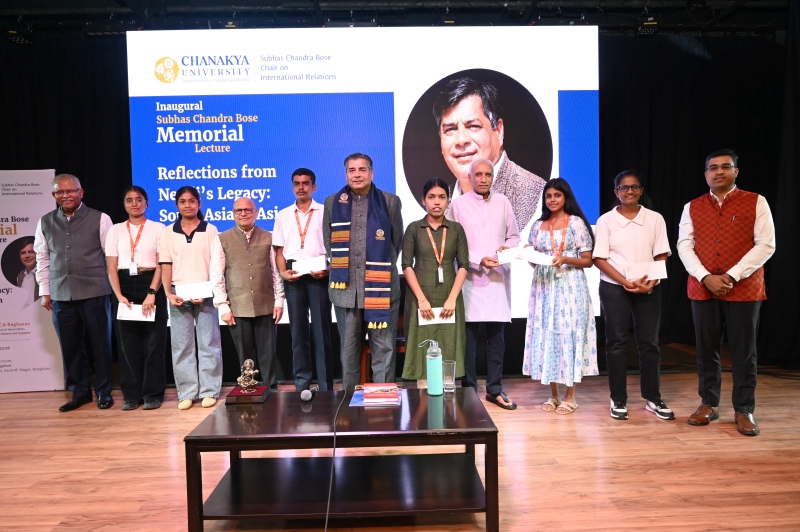
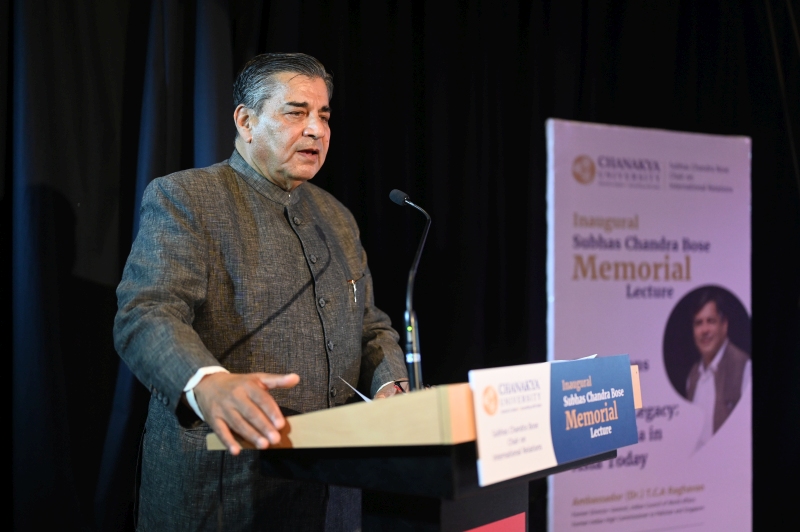
The Subhas Chandra Bose Chair of International Relations hosted its inaugural Subhas Chandra Bose Memorial Lecture on 12th February 2026 at Alliance Française de Bangalore. The event brought together scholars, diplomats, and policy practitioners for an evening of substantive engagement with one of modern India’s most consequential but underexplored legacies. Ambassador TCA Raghavan, former High Commissioner to Singapore and Pakistan, delivered the address, arguing that Netaji’s strategic vision remains a vital compass for India’s foreign policy in an era of deepening regional uncertainty.
Raghavan opened by contending that Bose, more than any other leader of the independence movement, situated India’s freedom struggle within a wider Asian geopolitical frame, understanding independence not as an end in itself but as India’s entry into a transforming world order. Drawing on his Singapore tenure, he reflected on the INA’s enduring role in shaping the dignity and political agency of Indian plantation workers, while acknowledging that the same history is experienced differently across communities. He suggested India could learn from Singapore’s maturity in holding conflicting historical memories without being paralysed by them.
The lecture traced the intellectual lineage of Asian universalism through Tagore and Keshab Chandra Sen, while cautioning that the idea of Asia has always been fragile, fractured historically by the China-Japan fault line and strained today by Chinese hegemonic assertion. Raghavan posed a sharp question: where does an Asian century end and a Chinese century begin? A defining contrast ran through the address, Southeast Asia’s transformation through ASEAN set against South Asia’s continued entrenchment in zero-sum rivalries. With SAARC dormant and BIMSTEC facing severe headwinds, regional cooperation in South Asia stands at its weakest in over two decades. Raghavan concluded by invoking Netaji’s realpolitik, his insistence on an Indian prism over borrowed frameworks, as the essential inheritance for a rising India navigating an exceptionally difficult neighbourhood.