
By Dr. Sanket Sudhir Kulkarni
Published Date: August 13, 2026
The Indian Air Force Chief Air Chief Marshal Amar Preet Singh had made an interesting remark about drones recently. While emphasizing the need for expedited development of drones, he also stressed on the need for developing indigenously made drone components and building robust supply chains for drones. Drones have proved themselves to be “game changing platforms” in modern day battlefield. They have demonstrated their effectiveness at every stage of conflict in the ongoing wars in Ukraine and the Gulf region. A senior Ukrainian official claimed that in 2025 alone, Ukrainian forces carried out 820,000 drone strikes against Russia. On the other hand, Russia launched 54,000 long range drones against Ukraine in 2025.
The operational effectiveness of Drones in Operation Sindoor and the way it is creating havoc in the Gulf region has further catalysed the conversation around its expedited procurement for the Indian Armed Forces. While the side with superior drone platforms enjoys a competitive advantage in battlefield, the drone warfare is also a battle of scales. The side which can manufacture batches after batches of drones to overwhelm the enemy’s air defences has an upper hand in combat. Therefore, drone warfare not just tests the troops’ ability but also a nation’s manufacturing and innovation capabilities to produce drones and assortment of components. To be able to do that, building indigenous components becomes imperative for countries like India to insulate these platforms from security threats and preclude any supply chain shocks owing to shifting geopolitics.
With respect to India’s drone sector, last two years have seen a flurry of activities. A report by FICCI-EY estimated the total manufacturing potential for drones and counter drones domestically to reach INR 1.8 lakh crores by 2030. An India Today report mentions that there are about 800 startups in India working on drone technology. Interestingly, some of Indian drone companies have also started receiving export orders.
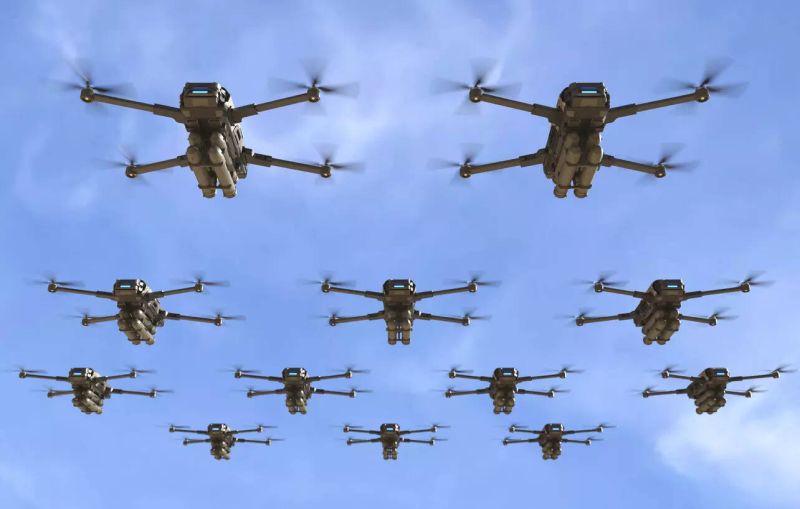
Back in September 2021, India introduced a Production Linked Incentive for Drone and Drone Components in 2021 to support indigenous development of drone industry. This is further complemented by the introduction of Electronic Components Manufacturing Scheme in 2025, which provides fiscal incentives to companies for manufacture of high-value electronic components like cameras, display assembly, printed circuit boards etc. Similarly, as Akarsh Srivastava notes in his detailed study that India has also started working on production linked incentive scheme for Advanced Chemistry Cell to plug the gap in domestic production of lithium-ion.
Additionally, in the last few years it has been seen that drone technology figures quite prominently in discussions with India’s foreign partners on defence cooperation. This aspect is particularly important, given that the nature of drone technology is a work in progress and international collaboration complements domestic technology development and helps gain exposure to evolving developments in this space.
Taiwan’s rendezvous with drone technology
Taiwan has been watching the usage of drones in Ukraine and how it is also shaping the Gulf conflict. It is also cognizant of how US-China talks are shaping up and hence embarked on a journey to build supply chain resilience in drone components space to safeguard against any Chinese military adventures. A report by Jonathan Harman notes that Taiwan has set a target of building capabilities to produce 180,000 drone per year by 2028, including through collaboration with “partner countries”. The report further notes that under the Taiwan Excellence Drone Industry Business Opportunities, it aims to facilitate connects between its local components manufacturers with prospective foreign collaborators. More so, given the global aversion towards China produced drone components, it is positioning itself as reliable source for alternative components supply chain.
With exception in areas like motors and batteries where it is unable to shed its dependence from People’s Republic of China, there are a plethora of drone components where it is building indigenous manufacturing capabilities. Citing media reports, Adil Brar notes that by 2024, with respect to drone components, Taiwan had achieved a self-sufficiency of 80 % and had in fact established a fund to encourage indigenous drone components manufacturing. Taiwan is also supporting some of its select companies to manufacture chips relevant for the drone industry and has set itself a target of being able to manufacture a one-third of its rare earth magnets requirements for drone industry by 2028.
Additionally, some Taiwanese drone companies with export ambitions are setting up manufacturing bases in US and elsewhere. Reports also cite that drones manufactured by Taiwanese companies are being sourced by Ukraine through third parties.
Synergies between Indian and Taiwanese Drone components companies
In his article for the Observer Research Foundation, researcher Ming-Shih Shen has already envisioned collaboration between India and Taiwan in the drone space. The joint electronic manufacturing partnership between Indian and Taiwanese companies provides a good template for emulating similar modalities of collaboration in the drone components sector.
Specifically, there exists sufficient space for Indian companies to partner and build synergies with Taiwanese drone and components manufacturers. Studies and analyses have indicated that India imports crucial components such as motors, navigation systems and battery packs from abroad. It would be pertinent to involve industry bodies from both India and Taiwan to chart a roadmap and identify specific components requirement for the Indian and Taiwanese drone industry.
Additionally, these industry bodies can also establish joint discussion and facilitation groups to enable investments, explore manufacturing partnerships and build synergies with innovation hubs and technical institutions of the two countries. Companies like Dixon Technologies have recently formed joint venture partnership with Taiwan’s Gemtek for the manufacture of optical transceivers. Similarly, Foxconn and HCL have recently entered into a partnership for the production of semiconductors in India. These successful case studies of collaboration between Indian and Taiwanese companies are encouraging reference points for deepening gamut of partnerships in sensitive dual use technologies such as avionics, navigation systems, and communication systems through joint ventures.
Over the last few years, there have been several States which have formulated their own aerospace and defence manufacturing strategy. For instance, the state of Telangana has 4 aerospace parks, with reported plans for two more. Tamil Nadu, hosts one among the two defence industrial corridors in the country and has built a facility for avionics at Sriperumbudur. A senior minister from the State Government of Karnataka was reported to have indicated that the Karnataka is probing the establishment of a dedicated defence electronics, avionics and sensor park. Cities like Pune and Nagpur in Maharashtra too have well-established ecosystem for development and manufacturing of high-end defence systems. Leveraging the infrastructure and already well-developed ecosystem around the above hubs, Indian and Taiwanese companies can explore establishing joint manufacturing facilities for drone components.
Another dimension of cooperation that needs to be explored is in the domain of critical resources required to build drone components. For instance, it is estimated that the annual requirement for lithium and neodymium in India stands at 13,671 and 766 tonnes respectively by 2030. A media report citing CII and EY joint study and other reports note that for minerals such as Gallium, Germanium, Tantalum, and the likes of it, India is completely reliant on imports. Industry bodies and think-tanks in India and Taiwan must jointly initiate efforts to map availability of such resources crucial for drone components manufacturing from reliable shores and also explore synergies to establish joint ventures and harmonise efforts to address each other’s resource gaps.
(The author is Assistant Professor at the Subhas Chandra Bose Chair of International Relations, Chanakya university, Bengaluru. His research interests include South Asia, Geopolitics, National Security and formulating strategy for Defence & Aerospace manufacturing)