
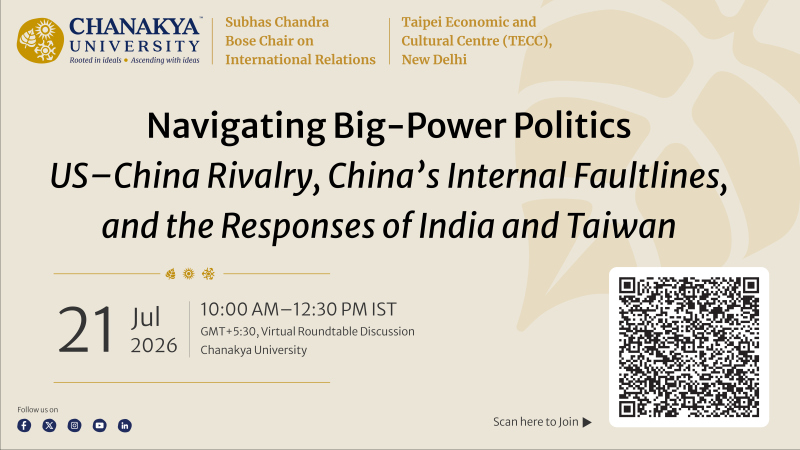
A Report on Virtual Roundtable Discussion Navigating Big-Power Politics US–China Rivalry, China’s Internal Faultlines, and the Responses of India and Taiwan
Webinar Report
Subhas Chandra Bose Chair of International Relations (SCB of IR), Chanakya University, in collaboration with Taipei Economic and Cultural Centre (TECC), New Delhi, organised a virtual roundtable discussion on “Navigating Big-Power Politics: US-China Rivalry, China’s Internal Faultlines and the Responses from India and China” on 21st July 2026. The Chair’s first international webinar brought together Indian and Taiwanese diplomats and scholars to discuss the changing strategic landscape amid the US-China rivalry. Consisting of two discussion panels, the first panel discussed “The State of US–China Rivalry: New Equilibrium or Deferred Stability?” and the second session discussed “India and Taiwan Navigating the US–China Rivalry”. The discussion was attended by participants from Chanakya University and scholars from Indian and Taiwanese Think Tanks and Universities.
Inaugural Session
The opening session began with the remarks by Mr. Ashok K. Kantha, Chair Professor, (SCB Chair of IR), Chanakya University. While welcoming the new collaboration with the TECC, he emphasised the importance of academic engagement between Taiwan and India.
His remarks began with a discussion on the US-Iran War and how it has revealed a change in the distribution of power and how states are exercising it. His discussion delved into the following: The US readily deployed military force in Iran. However, for the US, the full-fledged war incurred high cost. Cost not only in terms of resources but also credibility; and the outcome remains ambiguous. Iran, for many, has emerged or secured a relatively better strategic position in the conflict. China remains on the sidelines and has deliberately avoided any direct engagement or commitment. He also added that China has not yet had the leadership capacity to manage a major global crisis.
Secondly, he looked into the US-China tariff war, the truce in Busan in October 2025, and the Xi-Trump meeting in May. He argued that the Xi-Trump meeting has shifted the nature of engagement and balance of the rivalry; he left the rest of the discussion to the first panel. Thirdly, he mentioned China’s internal shortcomings and domestic political environment. He said that the domestic issues constrain Beijing from emerging as a great power and left the discussion for the second panel. Fourthly, he moved on to the Indo-Pacific. He said the US has not withdrawn from the Indo-Pacific. However, although the QUAD and its objectives remain intact, they are facing strain at the edges. To further clarify the argument, he added the US’ intent has not changed, but its reliability has; primarily because of the Trump administration’s increasingly transactional policies and the War in the Middle East, which has less bandwidth to sustain efforts required to manage the alliances. To set the stage for further discussion, he raised three questions: Is the US distracted or is it losing interest in the Indo-Pacific? What is the future of Indo-Pacific when its principal anchor for the past eight years appears to be a reluctant and more transactional participant? Can the region absorb a degree of “de-Americanisation”?
He commented that a wholesale collapse of the American alliance system – whether NATO or Indo-Pacific – is highly unlikely. Rather, they will likely emerge differently, and what is happening is not a rupture but a rebalancing.
Finally, he talked about China’s benefits from the current global disorder. He said that although China never favoured an alliance system similar to that of the US, it seeks partnerships of convenience to avoid binding commitments. He also raised doubts that the stabilisation of the India-China border may provide Beijing an opportunity to extract tougher concessions rather than a genuine accommodation. Besides, the US’ transactional approach has pushed New Delhi to be more cautious about investing heavily in a partnership without reliability. He said that concerns are increasing in Taiwan as it lacks an institutional alliance for a long-standing security relationship. Later, handed over the floor to Dr. Mumin Chen for his opening remarks.
Dr. Mumin Chen from the Taipei Economic and Cultural Centre in India, opened his remarks by mentioning how US decline in global influence and China’s rise have made the strategic environment around the Taiwan issue unpredictable.
He discussed how US presence in the Indo-Pacific ensured Taiwan’s security and how it is changing, adding that China is not only a major economic power but also increasingly an assertive military power in the region. He said that against this backdrop, Taiwan has begun preparing and adjusting foreign policy and national defence strategy. It has invested in developing indigenous defence capabilities, including submarines and UAVs, and an emphasis on social resilience, ensuring that the public can respond effectively during a crisis.
He also pointed out that Taiwan is one of the world’s top twenty economies and a global leader in several sectors, especially semiconductors and information technology. For this reason, Taiwan’s security is not a domestic issue but concerning for the international community, particularly neighbours such as India, Southeast Asian countries and Japan.
He said that because of Taiwan’s geographical and historical closeness to China, it has been observing one China and possesses greater experience and resources in understanding developments in China.
He concluded his remarks by adding that Taiwan is happy to continue cooperating with India, particularly Chanakya University, and organise more academic programmes and events on international relations and China studies.
Session I
The State of US–China Rivalry: New Equilibrium or Deferred Stability?
The session looked at “The State of US-China Rivalry: New Equilibrium or Deferred Stability” covering themes such as how do India and Taiwan assess the recalibration of US-China relations? Is it a present calm or a new equilibrium? How do China’s internal faultlines constrain its leadership aspirations?
The session was chaired by Mr. Ashok K. Kantha. The panel speakers were Mr. Manoj Kewalramani from Takshashila Institutions in Bengaluru and Dr. Roger Chi-Feng Liu, Director of the Integrated Diplomacy Programme, DIMEs, Taiwan Think Tank.
Mr. Ashok K. Kantha commenced with a discussion on the Xi-Trump summit in May and recalibration of the US-China relations. He said that for the first time, the US validated China’s framework of a “constructive China-US relationship based on strategic stability.” However, added that it remains uncertain what the US’ acceptance of the framework will imply for their bilateral relations in the future.
After discussing the above context, the Chair put forward three propositions. First, the recalibration between the US and China is a new equilibrium rather than a deferral of confrontation. Second, a weakened US does not automatically translate into a stronger China. Third, China still lacks the normative and institutional foundations required of a genuine global superpower.
He concluded his remarks by saying that India and Taiwan face similar issues in the context of this rivalry and require a balancing act. They should engage with the US, which has become less predictable and increasingly transactional while confronting China as a security challenge. Also, both India and Taiwan should de-risk from China without decoupling from it and deepen ties with the US without being a hostage to American policy.
Mr. Manoj Kewalramani, Takshashila Institution, Bengaluru, India
Mr. Manoj Kewalramani began by discussing the Xi-Trump summit. He started with the comment that many American scholars and China are overinterpreting and overstating the new framework between China and the US – a “constructive relationship of strategic stability.” The White House statement has clarified that such a framework will be based on fairness and reciprocity. Consequently, he said that although both sides now speak of strategic stability, the relationship is likely to continue experiencing considerable friction beneath that language.
His first point was that Beijing’s interpretation of the framework should not be accepted uncritically because the structural frictions between the US and China remain unresolved. He pointed out the following: First, China’s export of rare earths to the US remained below their average levels between 2022 and 2024 despite the Busan and Beijing agreements. Second, American security posture in the Indo-Pacific has grown stronger. It has increased its defence expenditure, expanded access to military facilities in the Philippines and Japan’s Ryukyu Island and increased the mobility of the Marine Corps in the region. Third, the 2026 US National Defence Strategy highlights a resilient and distributed Indo-Pacific posture ready to respond quickly to any decisive adversary moves. He suggested looking beyond the rhetoric of burden-sharing and political frictions created by Trump’s diplomacy.
His second point discussed what these developments meant for India. According to him, the US has adopted a more abrasive approach towards India, and it has reduced India’s readiness to engage with the US. He also talked about India-China relations in the past 18 to 20 months, where both sides have managed to reach greater stability. However, reminded that this opportunity is unlikely to endure indefinitely.
His third point was on how, through the new framework, China has publicly announced the competition as the defining factor of US-China relations. He referred to the Institute of China-America Studies, which says that by August 2025, Congress introduced 564 bills and regulations referencing China. It also implies that the strategic competition is receiving broad political support across the US.
Next, he delved into how India should navigate the fluctuations in US-China competition. He said self-strengthening must be the anchor of Indian foreign policy. When it comes to relations with the US, there shall be areas of inevitable accommodation and concession. However, he said India’s approach to US policies should continue to be dealt with calm and patience without unquestioned acceptance of every American demand. On China, he commented that it is a long-term security and strategic challenge in the region.
He concluded by describing the complex context in which the US dominates the financial architecture of the global economy, China dominates its industrial base, and Europe is rediscovering its strategic purpose. And that at this juncture, India should vie for more capability-driven plurilateral engagements and become a consequential power in selective strategic domains.
Dr. Roger Chi-Feng Liu, Director, Integrated Diplomacy Programme, DIMEs Centre, Taiwan Think Tank, Taipei, Taiwan
Dr. Roger commenced his talk with the question of whether the recent recalibration in US-China relations suggests the re-emergence of G2. He answered the question: US-China relations increasingly resemble the predictions made by the power transition theory, where a rising power seeks to challenge the international order and the status quo power tries to prevent that rise using various instruments. Also, on the Xi-Trump meeting, he said the summit did not prompt the stock markets or currency markets to react positively. It did not produce any positive outcomes for the US economy either, and the Renminbi also failed to strengthen. Hence, a strong G2 is increasingly unlikely, and the summit represented a temporary deferral of confrontation, with both sides using the pause to advance their strategic interests.
He also delved into the commitments announced during the summit, especially the proposal to establish a US-China investment commission, a joint governance mechanism for AI, and China’s promise to purchase additional Boeing aircraft and other American products. He questioned the reality of implementation of these commitments. To understand the reality of commitments made during the summit, he suggested assessing measurable indicators. He illustrated this by giving the example of China’s block on the import of Nvidia’s chips as an example. Later, China approved the import and relaxed restrictions on it, as these were deemed necessary to train their advanced large language models.
On Taiwan, he said that the major discussion around the summit was on the possible implications of the postponement of the previously promised American arms sales. He added that in response, the Taiwanese government has already begun implementing measures to address the consequences of the summit. On India, he said that the main discussion is its role in the Indo-Pacific and the shift among the US strategic community from using “Indo-Pacific” to “Asia-Pacific”.
He also talked about India’s role in QUAD and the rising debate that it has become irrelevant, to which he differed. He said that minilateral mechanisms continue to be major platforms for knowledge and technology exchanges. India continues to partner with Taiwan, South Korea and Japan in various sectors. He said that due to these reasons, QUAD remain important, especially QUAD 3.0, which focuses on emerging technologies beyond traditional security cooperation.
Session II
India and Taiwan Navigating the US–China Rivalry
The second panel session was chaired by Dr. Nishit Kumar, Assistant Professor, Subhas Chandra Bose Chair of International Relations at Chanakya University. The Panel featured Mr. Santosh Pai from the Institute of Chinese Studies and Dr. Naina Singh from National Chung Hsing University (NCHU), Taiwan as speakers. During initial remarks, the chairperson discussed the major questions of the panel: First, how does New Delhi sustain strategic autonomy and differentiated risking, reducing dependence on China without substituting a new dependence on the US? Secondly, how does Taipei build resilience and credible deterrence and diversify beyond the US as primary security provider as it emerges less reliable? Thirdly, where do India and Taiwan’s interests converge and what scope is there for like-minded partners to coordinate rather than face US-China rivalry alone?
Mr. Santosh Pai, Institute of Chinese Studies (ICS), New Delhi
Mr. Santosh Pai discussed practical opportunities for strengthening India-Taiwan economic cooperation. He categorised the opportunities into: diversification, de-risking, integration, and expansion.
On diversification, he talked about Taiwan’s role in helping India reduce its dependence on China through alternative sources of imports. He said that India has recently increased its imports of integrated circuits, printed circuit boards and chemicals from Taiwan and that it has helped India reduce its dependence on Chinese supply chains. On de-risking, he suggested focusing on areas where Taiwan has replaced China as the major supplier.
On integration, he said that Taiwan’s investments in India increased after 2020 in three broad groups: trust-based investments in semiconductors, integration into supply chains, and labour-intensive manufacturing. He said that India’s emergence as a major exporter of Apple smartphones is supported by over USD 1 billion in Taiwanese support and that this template can be replicated in other sectors. He said that one of the major policy challenges for India is integrating Taiwan’s supply chains into India’s network of free trade agreements. He also suggested expanding India-Taiwan cooperation to sectors where India already possesses a competitive base but requires technological upgrading, such as technical textiles.
He also suggested making use of joint ventures, mergers and acquisitions with Indian firms to facilitate technology transfer, modernise domestic industry and align with India’s policy of localising manufacturing.
On expansion, he has said that current Taiwanese investment in India is highly concentrated in Tamil Nadu and that similar industrial ecosystems can be developed in other Indian states by adopting Tamil Nadu’s policies.
He concluded by pointing out that in the domain of trade, investments and technology, can both sides get creative and instead explore fostering industrial partnerships which has the support of regulators from both sides.
Dr. Naina Singh, National Chung Hsing University (NCHU), Taichung, Taiwan
Dr. Naina Singh shared her observations based on her six years of experience in Taiwan. She focused on the question: How is Taiwan building resilience, strengthening credible deterrence and diversifying beyond the “silicon shield” when it relies on external actors for security, whose reliability is increasingly questioned?
She started her session by briefing the concept of the silicon shield and its challenges. She explained that the traditional argument of the silicon shield, where Taiwan’s dominance in the semiconductor industry discourages military action against the country, has become less certain. Because the US has been pursuing semiconductor diversification through several initiatives, such as the CHIPS Act, to strengthen domestic manufacturing capacity. She added that the US’ successful diversification and replacing Taiwan Semiconductor Manufacturing Company’s efficiency will reduce the strategic incentive for the US to provide security in the event of a conflict with China.
She added that China’s progress in the semiconductor industry and AI is a challenge to the silicon shield. She mentioned how during the 2026 World AI Summit, Shanghai demonstrated China’s technological capacity and the growth and potential to surpass Taiwan in advanced semiconductor production. She said that it implied a decreasing value of Taiwan’s semiconductor dominance as a deterrence.
She said that Taiwan, in response, has begun strengthening domestic resilience in other sectors, especially institutionalisation of an asymmetric defence strategy. She referred to Taiwan’s 2025 quadrennial defence review, which talks about multi-domain deterrence inclusive of cyberattacks, disinformation campaigns, damage to critical infrastructure and disruptions to submarine communication cables. The objective is to keep pace with Chinese military capacities through maximising asymmetric advantages. She also mentioned that Taiwan has invested heavily in indigenous missile systems, domestic defence industries and unmanned systems by adopting lessons from the Ukraine war.
Domestically, she said that Taiwan has invested heavily in its security preparedness by reforming military service and reserve forces. She mentioned that military training currently includes operational use of drones and technologies. She also talked about the societal approach to resilience, including awareness, defence exhibitions, community-level preparedness, psychological preparedness, social cohesion, infrastructure production, economic continuity and civil defence. She added that national-level resilience exercises are being conducted on a regular basis, and these drills included simulated disruptions on telecommunication networks and emergency procedures and evacuation protocols.
She concluded by commenting that Taiwan’s evolving concept of resilience is beyond military deterrence and it reflects a strategy of national survival under uncertain security conditions.
Discussion
The webinar was followed by an interesting discussion revolving around the following themes:
India’s capacity to become a consequential power in raw materials, AI supply chain, and technology talent
China’s deepening defence cooperation with countries like Pakistan and its reluctance to provide broader security guarantees
Potential for building components for drones between India and Taiwan, especially through joint partnerships
Taiwan’s concerted efforts to build resilience against cyber-attacks.
(The report is prepared by Ms. Anu Maria Joseph, Non-Resident Fellow at Subhas Chandra Bose Chair of International Relations at Chanakya University, Bengaluru)