
Roundtable on Concept and Predicate Commonality Across Indian Languages
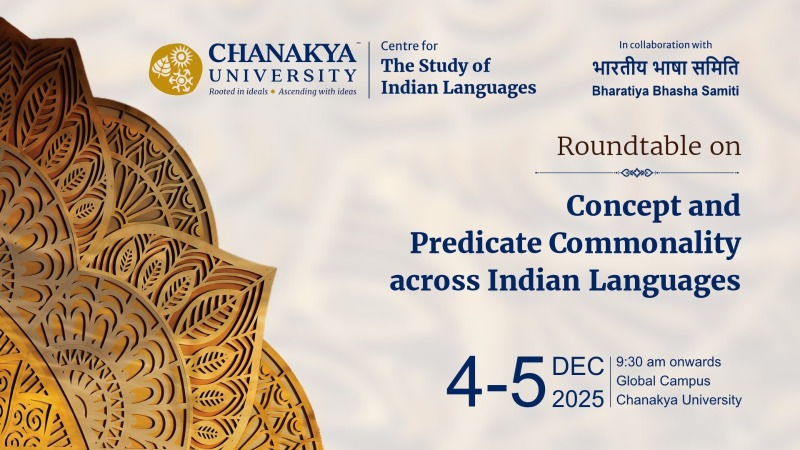
Day 1 began with Prof. Ashwin Kumar outlining CSIL’s research vision, emphasising its interdisciplinary scope across language, logic and culture. Honorary Professor B. Narahari Rao followed with an immersive session on the treating cultures as learnables. The session emphasized the need to reconstruct concepts and predicates from Indian texts in order to make them available for use and reflection. Prof. Nagaraj Paturi added an anthropological perspective, stressing the role of fieldwork in grounding conceptual inquiry.
The afternoon sessions bridged psychology, linguistics, and conceptual history. Prof. R.K. Mishra (Head, Centre for Neural and Cognitive Sciences, University of Hyderabad) discussed the historicity of concepts through a Hegelian frame, urging CSIL to initiate projects that examine mental structures of Indian cultures through textual and empirical methods. Dr. Shankar Rajaraman (Director of the Centre for the Study of Ancient History and Culture) illustrated how textual analysis can illuminate aesthetic categories such as Bhava.
The day concluded with a technical exploration of corpus linguistics. Prof. Niladri Shekar Dash (Professor and Head of the Linguistics Research Unit at the Indian Statistical Institute) presented contemporary corpus-building and archival methods with illustrations from major national projects. Sri B.S. Suryaprakash (DAKSH, IIT Delhi) discussed the evolution and relative stability of legal concepts rooted in institutional reasoning and everyday parlance.
Together, the sessions showcased the methodological depth and collaborative potential driving CSIL’s agenda on concept and predicate commonality.
Day 2 Recap | Roundtable on Concept and Predicate Commonality Across Indian Languages
Day 2 turned the spotlight toward humanities-led reflections on concept loss and the challenges of recovering conceptual worlds from Indian traditions. The morning opened with Dr. Vivek Dhareshwar, who highlighted the persistent gulf between lived experience and the explanations that contemporary theories and social-scientific studies have produced about Indian culture. He urged the Centre to incorporate Kurkoti’s insights on pratyabhijñā (recognition) as a way to deepen CSIL’s imagination and projects.
This was followed by Dr. Shashikala Srinivasan, who mapped how concepts within the Bhakti traditions have been studied so far, while noting significant gaps and unexplored research questions—especially concerning how practitioners themselves articulate intimacy, devotion, social roles, and divine relations.
One of the major verticals explored by CSIL on Day 2 was Archiving and Digital Technologies. Prof. Yoganandha C.S. shared his extensive experience across national digitisation efforts, offering practical insights on archival processes, metadata standards, and long-term preservation. Sri C.V. Venkatesh added the perspective of Samskrita Bharati, discussing their large-scale digitisation workflows and grassroots volunteer mobilisation. Their presentations triggered rich reflections on the need to avoid duplication of efforts, to envision a meta-site for archiving, and to address challenges related to funding, workflows, and institutional vision.
The afternoon session began with Sri Tanveer Hasan, who drew critical lessons from Wikisource digitisation and its applications. He clarified the conceptual distinction between archiving and corpus creation, and emphasised institutional constraints, compliance obligations, and the indispensable role of community participation and enthusiasm in sustaining such initiatives.
Prof. K.S. Kannan, Honorary Professor at CSIL, offered a thoughtful summary of the Centre’s scope and long-term vision, situating the diverse discussions within a unified intellectual framework.
The event culminated in a Roundtable that sparked collaborative synergies, seeded new research directions, and opened pathways for sustained dialogue and collective inquiry.