
A Report on Webinar – India–Nepal Relations: Reimagining the Partnership
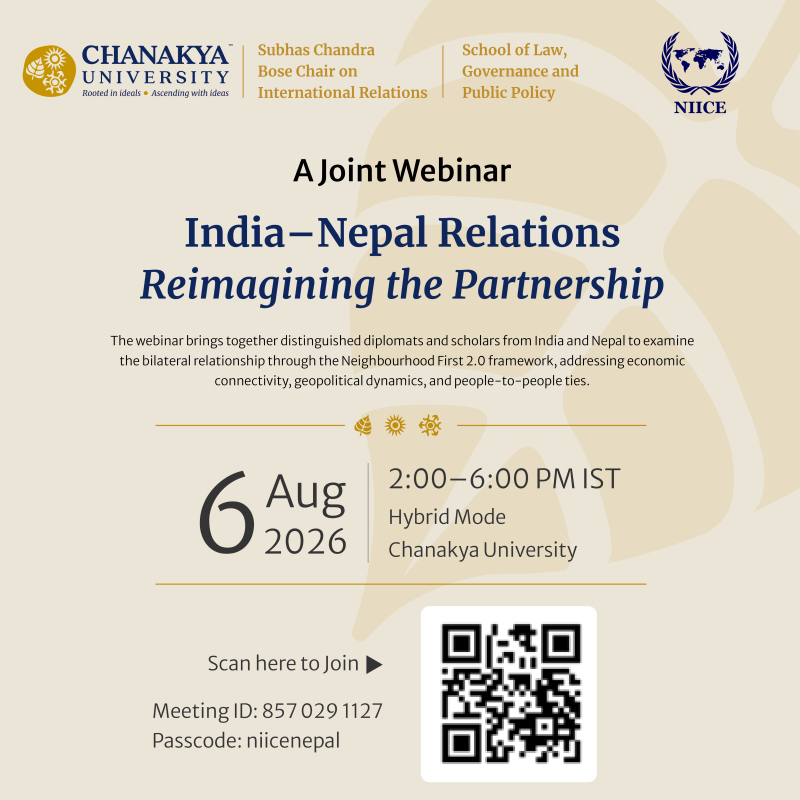
A Joint Webinar between
Subhas Chandra Bose Chair of International Relations, Chanakya University, Bengaluru
&
Nepal Institute for International Cooperation and Engagement (NIICE Nepal), Kathmandu
August 06, 2026 | 1400 to 1800 hrs
Chanakya University, Bengaluru
Executive Summary
The geopolitical uncertainties arising out of the ongoing political transition in Nepal necessitated the timely conduct of this webinar on reimagining the partnership between India Nepal. The bilateral relation, traditionally built upon a legacy of history and culture, is witnessing a realignment of sorts. The key consensus across strategic community is that the partnership should transform from its stage of “untapped potential” to “functional delivery” in order to stay relevant.
The webinar identified four core pillars which are instrumental in reimagining India Nepal partnership:
The Evolution of Neighbourhood First 2.0: From summit diplomacy to delivery-focused and institutionalized form.
Economic Delivery and Connectivity: Hydropower, digital integration and physical connectivity as the structural foundation of political stability.
Strategic Management of the China Variable: Leveraging India’s natural sociocultural strengths and structural interdependence by solving the problem of “delivery gap” which invites external players into the game.
The Institutionalization of People-to-People Relations: From “inherited trust” to building modern mechanisms of education, skills exchange and youth engagement.
Session 1
The “Neighbourhood First 2.0” Framework and Its Implications for Nepal
Prof. Ashok K. Kantha’s keynote address highlighted that India’s strategic destiny remains tied to its immediate neighbourhood. Nevertheless, “Neighbourhood First” policy is in need of a “2.0” upgrade in view of present demographic situation and breakdown of the global rules-based order. The rise of a confident and self-reliant national leadership in Nepal requires that New Delhi goes beyond classical narrative into the territory of strategic equals. The move towards a modernized framework calls for the analysis of the following limitations of the 1.0 era:
Implementation Lag and “Over-Securitisation”: The tradition of diplomacy being summit-driven and perceived through the lens of security or domestic politics resulted in persistent gap where declarative diplomacy always outstripped delivery on ground.
Integration Stagnation: Intra-regional trade is still underdeveloped, standing at paltry 5%, owing to underused private sector cooperation and multilateral mechanisms.
Diplomatic High-Handedness: There is a need to overcome terminology of being a “net security provider” which can alienate sovereign partners.
New Diplomatic “Mula Mantra”
To become the first responder in the region again, Prof. Kantha offered the following fundamental change of diplomatic posture: “India’s guiding principle in the neighbourhood must be: ask first, deliver fast, and never brag.” This humble approach is meant to replace perception of being a “big brother” with a “sticky” network of co-dependency. The focus on delivery “nuts and bolts” will help to build a sustainable partnership which is difficult for outsiders to unravel.
Session 2
Economic Partnership and Physical Connectivity: From Potential to Delivery
The second session of the webinar, titled “Economic Partnership and Connectivity – From Potential to Delivery”, was chaired by Prof. (Dr). Chetan Singai, Dean, School of Law, Governance and Public Policy, Chanakya University, Bengaluru. The speakers for the session included Dr. Prabir De, Professor at Research and Information System for Developing Countries (RIS), and Dr. Saurabh Kaushik, Research Fellow, Subhas Chandra Bose Chair of International Relations from India. The third presenter, Dr. Govind Raj Pokharel participating online from Nepal had served as the Vice Chairperson of the National Planning Commission at Nepal.
The session examined how India-Nepal economic partnership and connectivity can progress from potential to delivery. In his opening remarks, the Chair highlighted the deep civilisational ties, open border and people-to-people linkages that provide a strong foundation to India-Nepal bilateral relations. However, the existing political goodwill also needs to be translated into tangible economic outcomes, which can be achieved through advancing physical connectivity through railways, roads, hydropower and energy. Besides, institutional, regulatory and governance reforms can address persistent barriers to economic growth and connectivity and improve implementation. The discussion also placed the India-Nepal bilateral relationship within the broader context of regional integration initiatives such as the BBIN and the BIMSTEC. In his closing remarks, the Chair mentioned that the session aimed to identify practical ways to ease frictions, strengthen formal and institutional mechanisms and ensure timely delivery of outcomes that will contribute towards shared prosperity between India and Nepal.
Dr. Prabir De, Professor at Research and Information System for Developing Countries (RIS)
The key theme of the presentation by Dr. Prabir De discussed ‘From Potential to Delivery of India Nepal Trade and Connectivity’ in great depth. The discussion highlighted that India’s economic relations with Nepal are deeply integrated but at the same time also asymmetric. Nepal’s widening trade deficit and increasing dependence on India were particularly pointed. To address these issues, he emphasised on the need to focus on improved connectivity and infrastructure, greater diversification and integration of value chains, as this will be mutually beneficial to both India and Nepal. Furthermore, energy cooperation, digital trade facilitation and stronger regional institutions can help in addressing the existing connectivity challenges and substantially improve Nepal and India’s bilateral trade and overall relations.
Dr. De presented several arguments highlighting the current state of physical and economic connectivity between India and Nepal. One, Nepal’s trade deficit with India has widened and it imports much more from India than it exports. Two, Nepal’s landlocked geography and its dependence on Indian transit have naturally turned India into Nepal’s dominant trading partner. Three, although there is some progress in this regard, trade facilitation still remains a weakness for Nepal, especially when compared to India and Thailand’s advanced paperless and contact less border trade.
After the explanation of the impediments to connectivity, Dr. De highlighted some encouraging signs in terms of progress towards better infrastructure connectivity such as the Motihari-Amlekhganj petroleum pipeline which is an example of sustainable and quality infrastructure. He also mentioned that Nepal’s large hydropower has the potential to generate substantial export earnings by utilizing the expanding electricity transmissions networks. Dr. De recommended scaling up energy cooperation, promoting seamless digital trade, timely completion of key connectivity projects such as the Raxaul-Kathmandu railway line and strengthening testing and certification processes and simplifying customs procedures.
Dr. Govind Pokharel, Former Vice Chairperson, NPC, Nepal
The discussion by Dr. Govind Pokharel highlighted the need to deepen and institutionalise Nepal-India economic partnership. In order to facilitate their future economic relations, hydropower and energy trade are the central pillars. The speaker discussed that Nepal can significantly increase export revenues by expanding electricity generation that will ensure predictable and long-term access to markets in India and Bangladesh. He mentioned that hydropower is Nepal’s most valuable export opportunity as it has substantial hydropower potential. A further expansion to over 20,000 MW will make the electricity exports a major contributor to the country’s national revenue.
Dr. Pokharel argued that heavy reliance on short-term and open electricity markets has created revenue uncertainty for Nepal. Long-term PPAs (Power Purchase Agreements) are required to ensure stable and predictable export earnings. He highlighted the need for Nepal and India to have institutional mechanisms for equitable sharing of benefits, such as from the Pancheshwar Multipurpose Project which can generate benefits beyond electricity. The key challenges to deeper connectivity identified by Dr. Pokharel included transport costs, logistical constraints and non-tariff barriers within India that have increased the cost of Nepal’s exports and weakened their competitiveness. He also pointed out institutional and human-capacity constraints including limited bureaucratic capacity when it comes to project implementation and investment facilitation which has limited Nepal’s ability to benefit from bilateral economic opportunities.
Dr. Pokharel recommended Indian companies to establish joint ventures with firms in Nepal to support the country’s industrialisation and diversify Nepal’s production base. He also recommended establishing long-term electricity purchase agreements covering a substantial share, creating fair rules for third country involvement by separating project ownership and investment from the nationality of contractors and consultants, encouraging private sector participation in electricity generation and trade, and investing in capacity building using bilateral cooperation resources to train Nepalese bureaucrats in negotiation, procurement and finance.
Dr. Saurabh Kaushik, Research Fellow, SCB Chair on IR, Chanakya University
In his presentation, Dr. Saurabh Kaushik highlighted that India is Nepal’s dominant trading partner, accounting for around 63% of Nepal’s total trade while India’s exports to Nepal have grown substantially between 2004-05 and 2024-25, mainly through sale of manufactured goods. Dr. Kaushik highlighted that with an aim to improve connectivity between the two countries, Integrated Check Posts (ICPs) such as the Raxaul (Bihar) – Birgunj (Nepal), Rupaidiha (UP) – Nepalgunj (Nepal), among a few others, have been operationalised to streamline border infrastructure. Moreover, there are three operational rail corridors, particularly Jainagar–Kurtha/Bijalpura and Raxaul–Sirsiya, which provide passenger and freight connectivity, and also support trade, tourism, pilgrimage, and access to Indian ports. Proposed corridors such as Raxaul–Kathmandu and Nautanwa–Bhairahawa could further integrate Nepal’s major economic and tourist centres, including Lumbini, into the regional transport network.
The speaker further discussed 15 major cross-border transit points that facilitate agricultural exchange, local trade, passenger movement, and regional commerce. Some of these major gateways include Raxaul, Jogbani, and Jainagar supported by road and rail connectivity. These integrated checkpoints can streamline the institutionalised cross-border movement by grouping the customs, immigration, and warehousing into a single window terminal. Dr. Kaushik highlighted that energy cooperation with increasing cross-border electricity trade has created a growing source of revenue for Nepal and has strengthened regional energy integration, while preferential tariffs on imports from India compared with third-country imports have encouraged bilateral trade.
Among the major recommendations mentioned by Dr. Kaushik, the primary one related to automating the customs procedures through digital systems that will help prevent duty evasion and improve regulatory and environmental compliance. Digitisation will also reduce transit times by integrating customs, tracking, and terminal operations across the logistics chain. Another key recommendation was to expand and integrate the cross-border infrastructure, especially railways, roads and integrated check-posts. The speaker also recommended simplifying Nepal’s investment environment. This can be ensured by improving land acquisition, royalty structures, FDI procedures, local benefit sharing and dispute resolution mechanisms in order to attract more Indian private investment. Finally, like India, it was recommended that Nepal should operationalise a nationwide multi-modal tracking database across all border points, to create a seamless interoperable framework that will facilitate bringing significant share of informal trade under systematic monitoring thereby enabling more effective tracking of cross-border trade flows.
Session 3
Nepal’s Political Transition, The China Variable, and India’s Strategic Space
The session was Chaired by Prof. Ashok K. Kantha and included speakers such as Amb. Ranjit Rae, Dr. Nihar Nayak, Dr. Pramod Jaiswal and Amb. Dr. Dinesh Bhattarai. This session analysed strategic imperatives of the India-Nepal bilateral relationship and the geopolitical landscape within which it is situated. The session involved a discussion of the internal political and structural changes in Nepal, and the new strategic context created by the increasing involvement of China in Nepal’s internal affairs, along with the intense rivalry between Beijing and Washington acting as the backdrop in global politics. This session also examined how a new emerging generation of political leaders in Nepal attempt to manage their international alliances keeping development and effective domestic governance as their main priority.
Dr. Pramod Jaiswal, Research Director, Nepal Institute for International Cooperation and Engagement (NIICE)
Dr. Pramod Jaiswal began his remarks on the theme of the session by highlighting Nepal’s many political transitions since the 1950s. However, he remarked that the present-day domestic actors are much more vocal in diversifying the country’s foreign policy to serve economic interests. Dr. Jaiswal stated that China made an aggressive move in Nepal’s politics after the 2008 Beijing Olympics by creating contacts at all possible levels – specifically with the communists – to safeguard its security interests. He added that the geographic position of Nepal has hindered the possibility for it to ride on the back of the growth of its neighbours because it borders the remote and backward areas of both India and China, not major economic zones.
Dr. Jaiswal further added that the current Nepali government gives priority to development diplomacy, approaching all international partners equally according to their abilities to provide tangible development and economic benefits. He recommended India to accept and adapt to new economic expectations and aspirations of Nepal in terms of infrastructure, noting that Nepal needs to strike a balanced position respectful of China’s sensitivities—in particular, the One-China principle – and preserving its national sovereignty and strategic independence.
Dr. Nihar R. Nayak, Associate Professor, University of Delhi
Dr. Nihar Nayak opened his remarks by stating that India has been traditionally playing a prominent and visible role in midwifing major political transitions in Nepal, while China has largely remained a silent spectator in critical moments of regime change. Historically, Nepal’s involvement with China was caused by the fact that Nepal sought to use Beijing geopolitically to balance and neutralise Indian influence. However, the post-monarchy period saw China changing to an active multi-level strategy, including ODA, technical assistance, local security measures and structural funding for border districts in connection with Tibetan migrants.
Dr. Nayak noted that China does not have a hostile attitude towards India in Nepal but is compelled to increase its stakes because of growing Western interference and footprints in the region. He recommended that India conduct its relations with Nepal confidently, playing on its natural economic strengths, sociocultural and strategic interests, instead of competing with China and the US there.
Amb. Dr. Dinesh Bhattarai, Foreign Affairs Advisor to the former Prime Minister of Nepal Sushil Koirala; Nepal’s Permanent Representative to the United Nations
Amb. Dinesh Bhattarai opened his remarks by noting that Nepal is going through a twin transition: the internal one related to a political shift to a youth majority government and a structural one associated with breaking up of post-WWII international rules-based order. He mentioned that India is Nepal’s nearest neighbour, biggest economic partner and main facilitator for transit, of which there is no equivalence.
Amb. Bhattarai argued that the economic boom experienced by China allows it to expand its interest from mere economics into much more serious institutional and party-state level dealings. Unfortunately, he added, the untrustworthy profile of China’s relationship with Nepal remains intact, as the mere closeness of countries does not necessarily mean an understanding of political realities. Amb. Bhattarai recommended that both India and Nepal should establish a process that would encourage regular interactions through their existing list of more than 40 bilateral mechanisms to address the spoilers and irritants in the relationship, proposing that all future actions should be implemented on the basis of mutual trust, reciprocity in the sphere of territorial security, and the guarantee that no hostile actions against the other party would be carried out from each other’s territory.
Ambassador Ranjit Rae, Former Ambassador of India to Nepal, Vietnam, and Hungary
Amb. Ranjit Rae, at the outset, mentioned that India-Nepal relations are of a special nature, and frictions are expected to happen occasionally. He cautioned that instead of avoiding these friction points, India and Nepal should learn to manage them properly. Amb. Rae observed that the actions carried out by China in South Asia cannot be analysed without taking into consideration its duel with the U.S on a global scale. He noted that the political change in Nepal this time is distinct due to its pragmatic nature, where ideology plays a secondary role, whereas what actually takes precedence is the natural desire for anti-corruption and good governance initiated by the youth.
Amb. Rae argued that the decrease in the influence of the left parties in Nepal creates space for New Delhi to have a more favourable perspective related to Nepal. He recommended that India should continue to have confidence in its cooperation with Nepal and place an emphasis on the relationship rather than focusing on other countries and actors, proposing that Indian policymakers should concentrate on solving the problem of implementation, which has led to the notion that the promises offered by India cannot be translated into actions.
Session 4
People-to-People Ties, Youth Engagement, Development Cooperation, and Soft Power
This panel was Chaired by Amb. Ranjit Rae and examined the human dimension of the India–Nepal relationship — people-to-people ties, youth engagement, development cooperation, and soft power. The speakers for this session were Prof (Dr.) Chetan Singai, Ms. Puspa Kumari, Mr. Bibek Dhoj Thapa and Ms. Tanuja Pandey. Speakers discussed converting “inherited trust” into institutional trust through universities, skills frameworks and knowledge diplomacy, and set out concrete youth-facing initiatives on the Indian side. The Chair opened by stressing the need to listen and respond to youth aspirations and noted that inherited trust must be actively institutionalised and nurtured rather than taken for granted.
Prof (Dr.) Chetan Singai, Dean, School of Law, Governance and Public Policy, Chanakya University
Prof. Chetan opened his remarks by stating that people-to-people linkages between India and Nepal have to change from “inherited trust” (historical/cultural) to “institutional trust” (educational/skills/systems). This is crucial to resist “epistemic cruelty” or the hegemony of Eurocentric thoughts. This can be done through education, skilling and labour mobilities where universities, civil society and local governments play a crucial role.
Prof. Chetan mentioned that the unprecedented youth “demographic dividend” in both countries provides an opportunity for deriving a “diplomatic dividend” through regular academic exchanges noting that the current ITEC/ICCR model of exchange is largely one-way and needs to be institutionalised into two-way mobility. He also emphasised that Nepal and India can leverage their unrivalled civilisational links through promotion of indigenous knowledge systems and South Asian Transnational Education (TNE). South Asia Transnational Education (TNE) can shift India–Nepal academic ties from one-way student mobility to joint degrees, faculty exchange and shared research centres.
Prof. Chetan highlighted provisions within India’s NEP 2020 and National Skills Qualification Framework that can be “internationalised” for South Asian countries like Nepal offering a model for mutual recognition of qualifications in tourism, hydropower, healthcare, AI, logistics and digital services. His major recommendations included instituting an India–Nepal Young Leaders Fellowship, a Students’ Parliament, a Himalayan Innovation Challenge, an India–Nepal Knowledge Corridor linking Chanakya University, Tribhuvan University, Kathmandu University and think tanks, an India–Nepal Skills Mobility Framework, with an aspirational South Asian Higher Education Qualification Framework led by India and Nepal, and creation of policy labs on shared issues, feeding into forums such as the SCB Chair’s Neighbourhood Forum.
Ms. Puspa Kumari, Research Assistant, Vivekananda International Foundation
Ms. Puspa Kumari began her presentation by mentioning that India–Nepal ties are civilisational and structural with roughly 8 million Nepali citizens living and working in India, and more than 600,000 Indians residing in Nepal. Moreover, Indians make up about 30% of Nepal’s tourist arrivals. She highlighted existing engagements such as more than 1,500 scholarships offered by India annually to Nepali students, and more than 3,700 Nepali officials/professionals trained under ITEC since 2001 — supported by institutions such as the Swami Vivekananda Cultural Centre, the Nepal–Bharat Library, and the B.P. Koirala India–Nepal Foundation. Ms Kumari argued that the Gen-Z protests across South Asia have made youth-centric policy and engagement more urgent than before.
In terms of the major recommendations, Ms. Kumari proposed the establishment of an India–Nepal Youth/Visionary Mission with dedicated funding for scholarships, educational exchange, innovation hubs and startup support. She also advocated for operationalising the 2014 MoU on youth development cooperation, expanding ICCR scholarships toward AI, IT, data analysis, media studies and climate/disaster management, deepening sport and entertainment collaboration, including a South Asia film festival, launching a “digital ambassador” programme, collaborating on Nepal’s tourism-familiarisation trips for Indian content creators, building a more visible network of Nepali alumni of Indian institutions, supporting digital modernisation (e.g. UPI’s expansion to Nepal), organising borderland youth forums and open-border management courses, and promoting women and youth forums for inclusive policymaking.
Mr. Bibek Dhoj Thapa, Research Associate & Program Coordinator, Nepal Institute for International Cooperation and Engagement (NIICE)
Mr. Bibek Dhoj Thapa opened his remarks by stating that India had “failed to check the pulse” of Nepal and did not foresee the Gen-Z movement – which resulted in an unprecedented political change in Nepal that was homegrown and involved no foreign intervention. He mentioned that Nepal’s Gen Z views the “new,” rising India through the lens of opportunity rather than as a post-colonial “big brother,” and is less inclined than earlier generations to reflexively criticise India. However, what Gen Z expects from India is strategic autonomy and genuine partnership — not a big-brother relationship. Mr. Thapa highlighted how social media now shapes youth perceptions of India faster and more powerfully than traditional diplomacy or news media.
Mr. Thapa argued that India’s reliance on classical cultural linkages and Bollywood has lost its sheen as younger audiences in Nepal are drifting towards K-pop and anime that have captured the imagination of Nepali Gen Z more effectively. He also mentioned the delivery gap in building infrastructure that India promises such as the Janakpur cricket stadium that remains incomplete even after almost a decade of beginning construction. Episodes like these undercut goodwill towards India in Nepal. Mr. Thapa recommended that India should help build pilgrim-support infrastructure along Nepal’s pilgrimage routes since a large majority of the pilgrims at these holy sites are from India. He also recommended diversifying India’s soft-power outreach to resonate with Gen Z, following through on committed infrastructure, using sports diplomacy for youth outreach, and rebranding and better publicising India’s development assistance in Nepal.
Ms. Tanuja Pandey, Gen Z Activist, Nepal
Ms. Tanuja Pandey began by stating that there has been an erosion of trust in the India–Nepal relationship over recent years and there is a need for open dialogue as India’s regional role grows. She mentioned that the perception of a “comfortable” relationship between the countries can breed complacency, despite deep historical and civilisational ties, given that mutual trust between India and Nepal is declining. Ms. Pandey remarked that South Asia is in a phase of political instability, and as a major regional power, India carries a proportionately greater responsibility given its role as the de facto leader of South Asia. She added that rising hate speech and negative sentiment on social media, in both directions, is damaging the bilateral relationship.
Advocating the need for direct and open dialogue on border disputes and other friction points, she mentioned that leaving thorny issues unaddressed can fester disenchantment over the long term. Ms. Pandey highlighted the fact that given India’s large investment in Nepal’s hydropower sector, the two countries must cooperate on issues pertaining to climate change, remarking that India’s absence from platforms like Sagarmatha Sambaad on climate resilience was a missed opportunity. She recommended that India move away from a “big brother” posture to a genuine partnership, respecting Nepal’s sovereignty and strategic autonomy, by prioritising open, direct dialogue on sensitive issues such as border disputes and migrant worker welfare.
Policy Recommendations
In order to bring the partnership to fruition by translating its potential into delivery, the following mandates are recommended:
Create a mechanism to audit stalled “nuts and bolts” issues of infrastructure projects, like Pancheshwar Project and completion of Janakpur Stadium.
Reactivating the 40+ dormant bilateral mechanisms and synthesizing the EPG report to give a roadmap for negotiating treaty and border management.
Setting up an Erasmus Mundus–type of mobility programme in order to move from one-way flow of students to mutual recognition of degrees and joint research centres between Chanakya, Tribhuvan, and Kathmandu Universities.
Using sports diplomacy and IT startup ecosystems to bridge the trust gap amongst Gen Z and counter social media disinformation.
Scaling up 400kV transmission links and creating a nationwide multi-modal tracking system to integrate paperless customs and logistics platforms.
Overall, the Webinar’s conclusive message was that India–Nepal partnership needs to be re-thought on the basis of reciprocity, humility and speed of project delivery. By bridging the implementation gap and connecting with Nepal’s modern aspirations, India can ensure that its most intimate neighbour becomes its most resilient strategic asset in the neighbourhood.
(The report is prepared by Dr. Saurabh Kaushik, Dr. Faareha Usmani and Ms. Krutika Reddy from the Subhas Chandra Bose Chair of International Relations, Chanakya University, Bengaluru)