


Studio 07
Indian Languages, Digital Infrastructure & Collaborative Communities
Whose knowledge counts in the digital commons — and by what measure?
Six days of inquiry into India’s digital language projects — and your own real contribution to the digital commons.

When
20–25 July 2026
Six full days · 10am–5pm

Where
Chanakya university Global Campus
Devanahalli, Bengaluru

You earn
2 Credits
Certificate of Completion

Open to
All Students
UG, PG, PhD across schools + external participants
What you’ll do
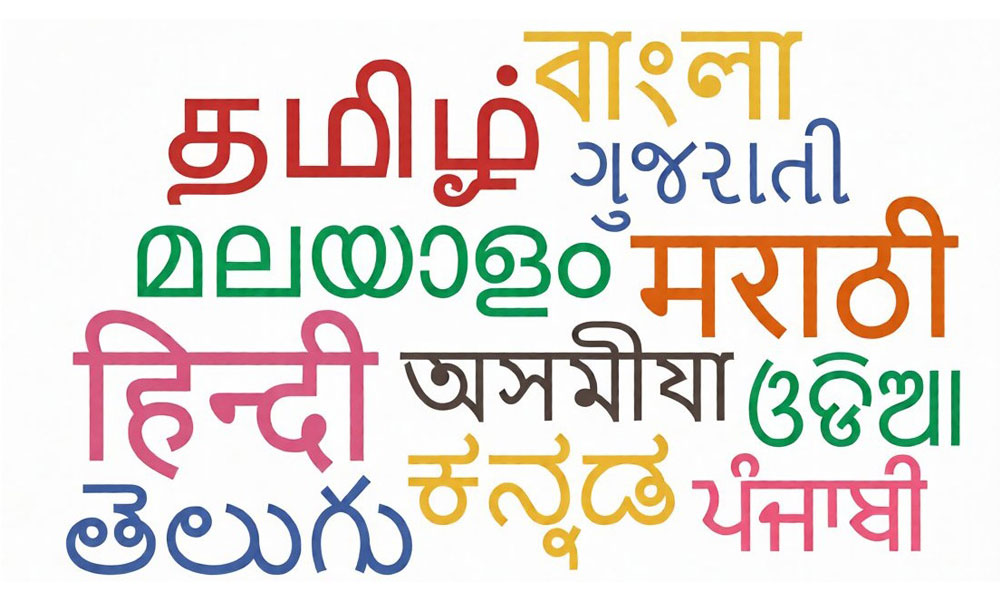
We are all passionate about our languages and emotional towards the ‘mother tongue’ — but do these languages contain knowledge or mere information? If they do contain knowledge, how do we evaluate it? How do we share it with other systems of knowledge? In the present digital constellations of data, information, and knowledge: whose knowledge counts, and by what measure?
These questions are urgent. Indian languages represent less than 0.1% of online content. AI models trained on English data fail when used with Indian languages, but those failures are invisible to the benchmarks meant to measure them. India has invested heavily in digitisation — the Million Book Project, the National Digital Library of India, Bharatvani, BHASHINI — yet research shows low awareness, poor accessibility, and weak community participation. These are failures of design and power, not of technology.
Across the studio, you’ll move from diagnosis to construction. You’ll map what has been built and what has failed. You’ll encounter theoretical lenses that challenge easy answers and confront the uncomfortable possibility that emotional celebration of Indian languages is not enough. Then you’ll build something small but real: a contribution to the digital commons on Wikipedia, Wikisource, Wikimedia Commons, or Wikidata.
What you’ll make
A tangible contribution to the digital commons — an edit, an upload, a proofread page, or a translated sentence — that demonstrates recognition and community-led value. On Day 6, you’ll also deliver a three-minute critical reflection on what you contributed, why you chose it, and what you learned about recognition, power, and community.
Your six days
- Days 1 to 4: Engagement in discussions, group work and critical analysis exercises.
- Days 4 to 6: Contributions to Wikipedia, Wikidata, Wikisource, Commons or translation.
- Day 6 (Showcase): A three-minute critical reflection on what was contributed, why it was chosen and what was learned about recognition, power and community.
How you’ll be assessed
| 30% | Participation (Days 1–4) — engagement in discussions, group work, and critical analysis exercises. |
| 50% | Wikimedia contribution (Days 4–6) — contributions to Wikipedia, Wikidata, Wikisource, Commons, or translation. Assessed for relevance, accuracy, and alignment with community-led values. |
| 20% | Showcase reflection (Day 6) — a three-minute critical reflection on what was contributed, why it was chosen, and what was learned about recognition, power, and community. |
Who it’s for
No technical background required. Open to students from all disciplines.
Important: there will be heavy pre-work. You’ll receive readings (in both digital and print) before the studio begins, and the instructor will follow up to ensure compliance.
Your instructor
Tanveer Hasan A K
Executive Director, Centre for Internet and Society (CIS), India
Tanveer Hasan A K is Executive Director of the Centre for Internet and Society (CIS), India. He has previously served on the Community Resources Team at the Wikimedia Foundation, supporting the development of the Wikimedia movement in South Asia. Earlier in his career he was an Assistant Professor at the Centre for Indian Languages in Higher Education at the Tata Institute of Social Sciences (TISS), Mumbai.
He has worked extensively with Indian-language Wikimedia communities — including Marathi, Punjabi, Konkani, Tulu, Odia, and Kannada — on Wikipedia, Wikisource, and other Wikimedia projects. His work has focused in particular on the revitalisation of small and under-represented Indian languages in the digital sphere through community-led, open-access approaches.

Registration open

Questions about a Studio?
Reach out to the Studios Coordinator. Happy to talk through any of the courses, what to expect day-to-day, or whether a particular Studio fits where you are in your learning right now.
Studios Coordinator
Anand K Sharma
cu.studios@chanakyauniversity.edu.in
+91 88930 33233
Campus
Chanakya University Global Campus
NH-648, Haraluru–Polanahalli
Near Kempegowda Intl. Airport
Devanahalli, Bengaluru — 562165