


Studio 11
Design Thinking for Creative Problem Solving
An interdisciplinary studio in human-centred problem solving
Six days of empathising, defining, ideating, prototyping, and testing — in mixed teams, on real-world problems.

When
20–25 July 2026
Six full days · 10am–5pm

Where
Chanakya university Global Campus
Devanahalli, Bengaluru

You earn
2 Credits
Certificate of Completion

Open to
All Students
UG, PG, PhD across schools + external participants
What you’ll do
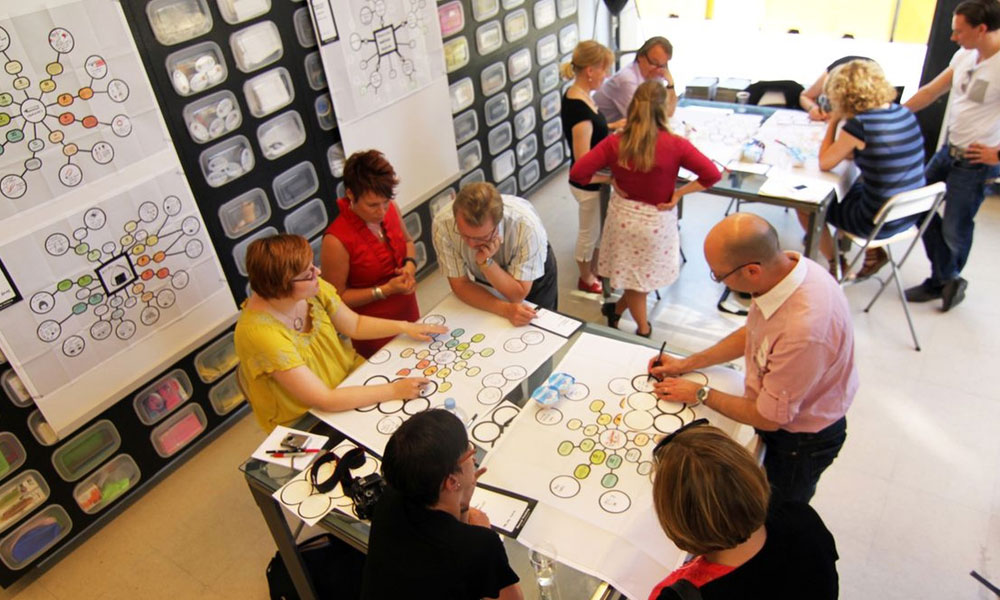
This is an immersive studio where you and students from very different disciplines come together to appreciate, then tackle, real-world problems. You’ll navigate the five classic stages of design thinking — empathise, define, ideate, prototype, test — with empathy, creativity, experimentation, and innovation directed at finding workable, sustainable solutions.
It is deliberately much more than classroom teaching. You’ll observe, interview, sketch, story-tell, ideate in many directions, rapidly prototype, and test — working in diverse teams that combine the perspectives of engineering, law, management, life and allied sciences, humanities and social sciences, media, journalism, and economics. Active engagement, learning-by-doing, reflection, and iterative experimentation run through every day.
What you’ll make
In teams, you will produce and exhibit:
- A real-world problem statement
- An empathy map and ideation / concept boards
- A prototype model, digital illustration, or conceptual framework (discipline-dependent), exhibited as a video or animation where possible
- A pitch — presentation, both oral and digital
The final showcase is evaluated by an external evaluator.
Your six days
| Mon | Empathy-based problem identification. Introduction to design thinking; ice-breakers and interdisciplinary team formation; choosing your problem statement; team-led observation walk; empathy mapping and stakeholder identification. |
| Tue | Understanding end-users and defining the challenge. Interviews and field visits (or secondary data); capturing data through conversation, observation, pictures, sketches; framing problem statements (“How might this be …”). |
| Wed | Ideation and finalising the concept. Divergent thinking exercises; brainstorming; concept drawing, storyboarding, or digital story design; idea selection matrix; team-by-team mentoring. |
| Thu | Prototyping and experimentation. Rapid prototyping; mock-ups; scenario building with role-play; user feedback collection (via simulation); refining your prototype. |
| Fri | Testing, iteration, and storytelling. Prototype testing with peers / users; feedback incorporation; visual storytelling; reflective learning; pitch preparation. |
| Sat | Pitching and exhibiting. Final exhibition and demo showcase; team presentations and pitches before the jury; reflection and closing. |
Sessions run full-day (approx. 10am–5pm). No more than 1–2 hours of theory per day; the rest is hands-on.
How you’ll be assessed
Evaluation in this studio is continuous and entirely practical—there are no conventional written tests. Your progress will be measured through daily observation, collaborative peer reviews, and a final jury assessment. The rubric-based grading breakdown is as follows:
- Empathy Mapping & Ideation (30%): The depth of your research and creative brainstorming process.
- Prototype Development (20%): Your approach to building, testing, and refining your solutions.
- Final Presentation & Pitch (20%): Your final exhibition and ability to communicate your concept to a jury.
- Team Participation & Engagement (15%): Your active involvement, teamwork, and contribution during studio hours.
- Problem Identification (15%): Your ability to accurately define and frame the core challenge.
Who it’s for
Open to UG, PG, and PhD students from every discipline. No prior knowledge of design thinking is needed. The focus is on human-centricity, hands-on experiential learning, and the social skills of collaboration and creativity — not on seeking perfection.
What to bring
A laptop or mobile device for digital prototyping. The studio provides chart papers, sticky notes, markers, board pins, pencils, basic prototyping materials, AV aids, and Wi-Fi-enabled space; seating is in round-table clusters of 3–6 with an exhibition / display area.
Your instructor
Dr. Pratima Khandelwal
Dr. Pratima Khandelwal is an academician, institutional leader, and the founder of FlyHigh, Bengaluru, an initiative dedicated to professional skill development and career empowerment. She functions as a core startup mentor and educational strategist, collaborating with higher education frameworks across India to update pedagogical models and cultivate an entrepreneurial mindset.
Her work centers on moving beyond traditional learning structures to embrace human-centric innovation, iterative problem solving, and design thinking workflows. Her studio guides students through active ideation, validation systems, and creative strategy execution to solve real-world challenges.

Registration open

Questions about a Studio?
Reach out to the Studios Coordinator. Happy to talk through any of the courses, what to expect day-to-day, or whether a particular Studio fits where you are in your learning right now.
Studios Coordinator
Anand K Sharma
cu.studios@chanakyauniversity.edu.in
+91 88930 33233
Campus
Chanakya University Global Campus
NH-648, Haraluru–Polanahalli
Near Kempegowda Intl. Airport
Devanahalli, Bengaluru — 562165