
Dr. Charu Ratna Dubey
Published Date: August 10, 2026
The world was nervously witnessing the 52nd G7 Summit held in France. This was probably the first time when the summit took place under the shadow of two wars – one in Europe and the other in West Asia. Leaders from G7 along with EU as non-enumerated member and several partner countries including India, Brazil, South Korea, Kenya and Ukraine gathered to discuss the overarching theme Working Together to Address Major International Challenges. The leaders of the G7 issued statement on the geopolitical situation that categorically focused on Ukraine, Middle East and Indo-Pacific. It is noteworthy that India repeatedly received invitation to attend the Summit since 2019, an indication of its rising economic profile, technological prowess and stature within international politics.
India’s Rising Profile
India is consistently outpacing other economies with an impressive GDP growth rate and development trajectory. Since 2000, as per the World Bank data, Indian economy has nearly quadrupled in real terms and tripled in terms of per capita income. In 2003 Goldman Sachs report postulated that India’s economic growth would overtake Italy, France and Japan by 2032. However, India surpassed Italy and France in 2025 itself. In its January 2026 forecast, International Monetary Fund (IMF) predicted India’s GDP growth at 7.3 percent in 2026. Such growing economic clout of India makes it a natural choice to attend the Summits despite not being a member of G7.
India is also showcasing its strength in other areas such as technology. From being a technology consumer to a global innovator, India’s transition is remarkable in various fields of science and technology. By successfully landing its spacecraft under Chandrayan-3 mission near the South Pole of the moon in 2023 along with the launch of its first Solar Aditya L1 mission in the same year, India broke the barriers of low-cost high-impact space missions. India AI Mission to democratise the AI space demonstrates India’s willingness to contribute to the field of artificial intelligence. India is also positioning to capture the space of chip making and global chip supply under its ambitious Semicon India Programme by developing the state-of-art infrastructure. India’s Unified Payment Interface (UPI) is an example to lead the world serve as global gold standard for financial inclusion. The growing economic and technological clout is helping India improve its image among global peers. Consequently, the countries of the Western world are looking for closer partnership with India.
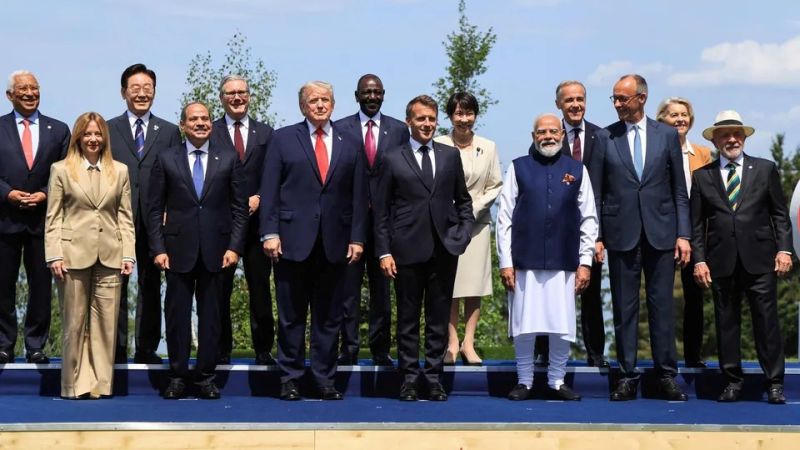
Image Source: AFP (as published in Hindustan Times on July 01, 2026)
G7 and the Search for Relevance
Despite the above advantages, India’s geo-strategic location in the Indo-Pacific combined with the rise of an aggressive China put India into a unique sweet-spot. To tackle this emerging threat G7 needs India more than ever before. China’s growing influence in global trade, control over global supply chain, massive investment in AI and emerging technologies along with its domination in the global rare earth mining and refining technology is also posing an unprecedented challenge to G7 countries.
Rise of China, along with the emergence of India, Brazil, South Africa and other countries of the Global South has pushed G7 to rediscover its plausible relevance in the evolving multi-polar world. More so, the presumptive growth of smaller organisations such as BRICS, the Shanghai Cooperation Organization (SCO) etc. are challenging the hegemony of G7 by offering alternative platforms for global economic, technology and security governance outside the ambit of West-led institutions. In view of multiple forums available to deliberate issues of global significance, G7 look for partners beyond the traditional West, to remain relevant.
India’s neutrality during the recent wars and its commitment for a rule based international order projects it as a reliable partner for the Group. By not aligning with any of the warring sides in the ongoing conflict in Ukraine & West Asia and pushing for peace, India retained its strategic autonomy. Its adherence to meet the Sustainable Development Goals (SDGs) by integrating national development agendas with the goals exhibits India’s allegiance to global concerns. India’s role in climate negotiations, development finance and in flagging the concerns of the Global South projects it as a bridge power between the developed North and emerging South. The evolving role of India is not going unnoticeable.
India: A Bridging Power
As a bridge between the West and the Global South, India and G7 had explored cooperation in supply chain resilience, clean energy transition, AI governance and critical technology. For instance, through building infrastructure and supply chain diversification under Partnership for Global Infrastructure and Investment (PGII), G7 and India are addressing common geo-economic concerns. India is also extending its support to various shared initiatives such as International Solar Alliance and Global Biofuel Alliance with a goal to achieve clean energy transition.
However, there are challenges and differences that could impact the evolving trajectory of cooperation between G7 and India. A major bone of contention is India’s bonhomie with Russia as single largest oil supplier. Nearly half of India’s crude oil comes from Russia which does not bode well with European countries. As a result of US- Iran war and the ensuing closure of Strait of Hormuz, the oil trade between India and Russia had further accelerated. Moreover, on the question of trade, there are major differences between India and Europe. Europe levies high import duties on agricultural and industrial exports such as European union Carbon Border Adjustment Mechanism (CBAM). West-led economic sanctions against Russia does not align with India’s strategic interest causing friction. Other areas of disagreements include differences over AI regulation, governance and standardisation. Although India is committed to achieve Net Zero by 2070 and actively engaged in initiatives like International Solar Alliance, differences persist over Common but Differentiated Responsibility, Climate finance and Coal Phase-Out strategy.
Notwithstanding, India’s active participation in G7 meetings reflects a shift from western domination to a step towards inclusive governance and accommodate multipolar realities. While the engagement between the two may continue, it is unlikely that India will formally become a member of G7. Nevertheless, it is expected that India will continue to play its role of a bridge builder between the developed and developing world.
(Dr. Charu Ratna Dubey is an Assistant Professor at the School of Arts Humanities and Social Sciences, Chanakya University. His area of research interest includes Indian foreign policy and diplomacy)