
Saurabh Kaushik
Published Date: August 6, 2026
On July 20, a cargo train carrying 40 containers of mustard seeds arrived at Budhnagar in Biratnagar, Nepal from Kolkata port. It was the first such instance of a cargo train directly transporting third-country imports from India to a railway station inside Nepal. Although the service was first launched in June 2023 during the inauguration of Biratnagar Integrated Check Post (ICP) and Jogbani-Biratnagar broad-gauge rail link by Prime Minister Narendra Modi and the then Prime Minister of Nepal, it had remained suspended until now. This marks an important moment in the context of deepening connectivity between India and Nepal.
Until recently, Sirsiya Dry Port in Birgunj was the only rail-linked dry port housing an inland clearance (container) depot in Nepal that handled third-party break-bulk and containerised cargo coming from Kolkata/Haldia and Visakhpatnam ports. It also handles heavy cargo arriving from major export destination in India such as Delhi, Ludhiana, Nagpur and Ahmedabad. Birgunj lies across the border with Raxaul (a major transit hub handling over 70 percent of Nepal’s total imports) in Bihar. There are plans to extend the railway line connecting Raxaul with Birgunj all the way to Kathmandu that will act as the central artery of transit and trade with Nepal’s capital in the future. That is still a long time away, though. For now, the goods received at the border at Birgunj via rail are further transported inland on roads and highways on trucks and heavy-duty vehicles.
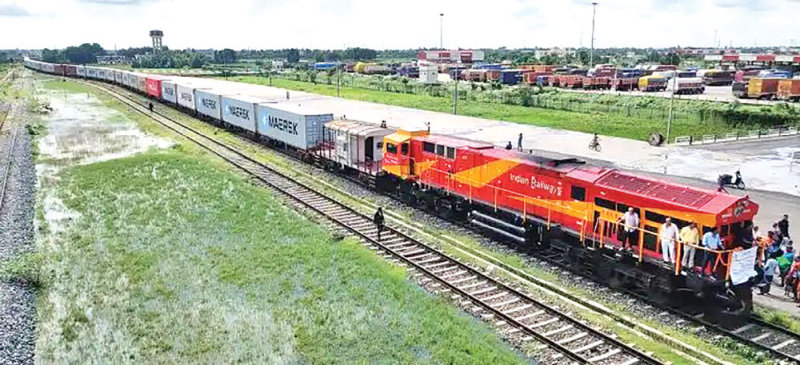
Image Credit: The Rising Nepal
What is clear is that operationalisation of the commercial container freight train service from Jogbani in India’s Bihar to Biratnagar in Nepal provides impetus to rail connectivity efforts that had been trudging along at snail’s pace for several decades. The Consulate General of Nepal in Kolkata in coordination with the Container Corporation of India Limited (CONCOR), Kolkata Customs and Kolkata Port have managed to add a crucial artery in the Indo-Nepal trade and transit architecture that will bring relief to industrialists and importers in eastern Nepal and contribute to overall regional development in Morang, Jhapa, Sunsari, Dhankuta and Panchthar districts.
Historically, several projects have been initiated, clearances provided, feasibility studies carried out, construction started and yet have not managed to see the light of day. Exigencies stemming from reneged political patronage due to machinations of power politics have acted as the chief spoiler in this regard. Moreover, technical constraints and regulatory setbacks have also contributed to the malaise in bilateral connectivity.
The roots of bilateral railway connectivity lie in the Rail Services Agreement signed in 2004. A Letter of Exchange (LoE) of Rail service Agreement (RSA) between Nepal and India was signed on 9 July 2021 resulting in a progressive momentum and expediting of railway connectivity. The LoE provided for the utilization of Indian railway network by all cargo train operators (not merely Indian government-owned) to carry inbound and outbound containers from Nepal whether to India or third-party states. Effective adoption of these policy provisions in the recent past has hinted at increased efficiency and cost-competitiveness for the Nepali market.
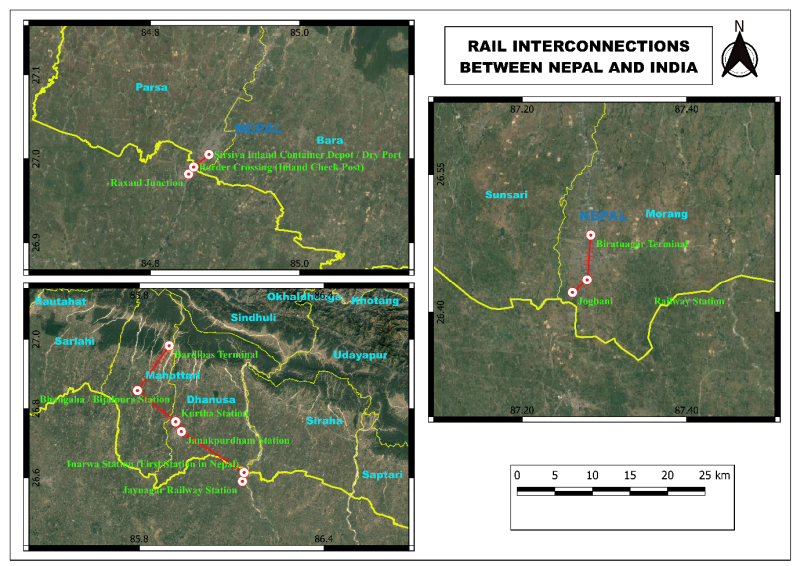
Map 1. Existing Railway Interconnections between Nepal and India
Source: Authors’ representation using QGIS based on publicly available data
In a Press Information Bureau release in January 2021, the Ministry of Railways, GoI reported the successful completion of 34.90 km of Jayanagar (India)-Kurtha (Nepal) section of the 68.72 km Jaynagar-Bijalpura-Bardibas rail project. Regular train services began in this section on 2 April 2022 and have been operational since. The expansion of the rail infrastructure to Bijalpura and onward to Bardibas faced issues related to encroachment and compensation.
The Kurtha-Bijalpura section is now complete and the construction of remaining 18 km stretch to Bardibas has picked up pace since early July after the resolution of a compensation dispute. Indian Railway Construction International Limited (IRCON), an Indian railway Public Sector Undertaking (PSU), is carrying out the construction work in close coordination with Nepal Railway Company in a project that will facilitate faster transportation promoting tourism, investment and regional development for the local population of Mahottari and Dhanusha districts in Nepal.
Apart from the physical connectivity in terms of infrastructure, what is essential for seamless movement of rail cargo are the procedures and rules that govern their movement including the integration of modern technology and digitalisation. In this regard, transformatory change has taken place over the last decade. Doing away with the need for manual verification and physical paperwork, current procedures of the Central Board of Indirect Taxes and Customs (CBIC) entail the adoption of digital technology for customs and transit related procedures. Bilateral or third-party trade is now initiated using an electronic Bill of Lading (B/L). Thereafter, an Electronic Import General Manifest (e-IGM) is issued that provides a digital legal declaration of the contents of a cargo/shipment on the ICEGATE Portal. An Electronic Customs Transit Declaration (CTD) and digital Delivery Order (D/O) then facilitate the transport of imported goods through Indian territory. Vehicles used for transit and transport of cargo are tracked using Electronic Cargo Tracking System (ECTS) that has replaced the requirement of physical lock on containerised cargo with high-security GPS/RFID-enabled ECTS smart locks.
These recent developments point to the fact that things are definitively moving forward in terms of connectivity and bilateral economic integration between India and Nepal. There is a serious reckoning within policymaking circles of the need to evolve from idea-based and emotive modes of transboundary governance to a sector-specific governance architecture that delivers tangible outcomes for both countries. This bodes well for both Nepal, which is undergoing a political transition, and India, that is gradually and systematically overhauling its internal and bilateral infrastructural landscape to facilitate a regional apparatus of integration.
The nature of physical interlinkages between Nepal and India would be a deciding factor in the success of India’s Neighbourhood First policy. If the volume of informal trade and unaccounted for interactions are minimised, and a system of registered trade institutionalized, there can be multiple and overarching benefits that can be derived from the same. Rail connectivity can provide the bedrock for the institutionalisation of multimodal connectivity between Nepal and India. It can provide direct freight movement and significantly reduce both the transit time and logistical costs since a direct cross-border rail link eliminates the need for transshipment (unloading and reloading) at the border. It will also expand the quantity and quality of passenger commute between the two countries facilitating the movement of pilgrims to several religious sites present in the region.
Nepal is currently navigating a period of significant domestic change. The nation has experienced considerable political flux in recent years, with successive coalition governments in Kathmandu unable to implement the terms of the mandate they were provided by the electorate. A stable government, which now appears to be firmly in place in Nepal, is essential not only for its own developmental trajectory but also for making strategic foreign policy choices that balance its sovereignty with the economic realities of its geography. Managing this political transition effectively is crucial for restoring strategic trust between New Delhi and Kathmandu after periods of political turbulence. There is renewed energy with the formation of a new government in Nepal. It is pertinent for India to engage with Nepal on considerate terms sidelining considerations of reciprocity. After all, good neighbours, especially those with significantly more heft, host without prejudice and treat without expectations.
(Saurabh Kaushik is a Research Fellow at Subhas Chandra Bose Chair of International Relations, Chanakya University, Bengaluru)