
A Report on Regional Economic Integration in South Asia: Opportunities and Challenges
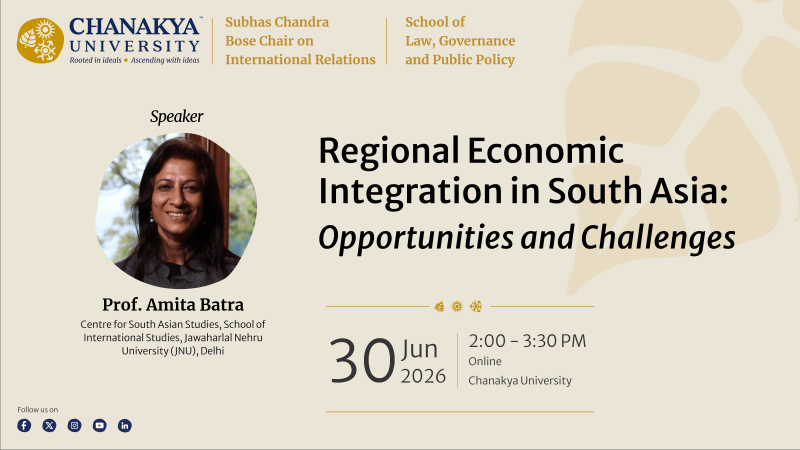
The Subhas Chandra Bose Chair of International Relations (SCB Chair of IR) at Chanakya University hosted Prof. Amita Batra for a talk on ‘Regional Economic Integration in South Asia: Opportunities and Challenges’ on 30th June 2026. Prof. Amita Batra specialises in regional trade issues and is a senior faculty with the Centre for South Asian Studies in the School of International Studies at Jawaharlal Nehru University in New Delhi. The webinar was chaired by Sri. Ashok K. Kantha, Chair Professor, Subhas Chandra Bose Chair of International Relations.
The talk and the discussions centred around identifying key issues that influence regional economic integration within South Asia. It was attended by students, scholars from different institutions and team members from the SCB Chair of IR.
Prof. Chetan Singai, Dean, School of Law, Governance and Public Policy, Chanakya University welcomed the speaker and noted that South Asia stands at a critical juncture where economic cooperation, connectivity, and regional partnerships are increasingly shaping the way we look at the region. He also emphasised the role of regional partnerships in promoting sustainable development and the importance of building resilience.
Sri. Ashok K. Kantha, Chair Professor, SCB Chair of IR, began his remarks by noting that Prof. Amita Batra is one of the finest authorities on regional trade and economic policies and has written several books and papers on the subject. He mentioned that in terms of intra-regional trade, South Asia is one of the least economically integrated regions, with just about 5 per cent of the region’s total trade. He mentioned that India’s own trade with the SAARC has remained relatively static. He also noted that the regional value chains in this region are not as robust as compared to those in East Asia or the European Union. Interestingly, as per ITC Trade Map data, last year China had a trade surplus of US$ 167 billion with the SAARC region (with India alone, the trade surplus is US$ 116 billion). He also noted that the popular perception suggests that South Asia is the least integrated region in terms of formal trade; however, the unrecorded and informal trade is much more.
Prof. Amita Batra began her talk by mentioning that current teaching in international relations is devoid of economic theory and thought. However, understanding these aspects is very significant for the study of foreign policy. Prof. Batra noted three major developments in the last half a decade that have infused shocks in the global trade system, which have compelled countries to strengthen their economic resilience.
Prof. Batra mentioned that the shocks caused by the COVID-19 pandemic brought forth the importance of single-source concentration and led to the translation of national security into economic security. It made the world realise that it was critical not to depend on one source, particularly in the context of the supply of critical inputs. The COVID-19 pandemic led to the closure of cross-border services and highlighted the implications of having a single source of concentration for the supply of critical goods.
Prof. Batra also noted the shocks brought in by US President Donald Trump’s reciprocal tariffs and weaponisation of trade. She noted that the tariffs imposed have no sound economic logic and this has in turn led to the distortion of global integration and restructuring of global trade, supply chains and exploration of new trade routes. Prof. Batra also underlined the shock induced by the Russian invasion of Ukraine and the West Asian crisis. She mentioned that the closure of the Strait of Hormuz was not anticipated and came as a big surprise. The closure of the Strait of Hormuz and attacks on Gulf Cooperation Council countries exposed the vulnerability of the globe to this region’s events. South Asians have been particularly hit in the context of remittances, labour migration, oil and gas imports, fertilisers, and their subsequent impact on agriculture and food security.
She further noted that despite having all the complementarities which align with the natural trading partner theory, the intra-regional trade in South Asia has remained at 5 % to 6 per cent. Unlike the SAARC Preferential Trade Agreement (SAPTA), the South Asian Free Trade Agreement (SAFTA) was a comprehensive and marked improvement but faced challenges in terms of a large number of negative lists. Until the 2010s, the services sector was excluded from the regional trade agreements. Compared to South Asia, other regions around the globe were quick to realise the importance of adopting tariff liberalisation for regional integration back in the early 1990s. She also noted that SAARC had no trade agenda and was more focused on poverty reduction, growth and reliance.
In her opinion, other aspects inhibiting intra-regional trade include the absence of a free trade area to date, the inability to scale down the size of the negative list, and the non-inclusion of the services sector until the South Asian Trade and Services Agreement in 2010. From the perspective of trade facilitation, she noted the lack of regional transit systems, lack of common transportation systems and cumbersome procedures, inspection and paperwork, which impeded the smooth movement of goods.
On the question of addressing India’s trade deficit vis-à-vis other regional countries in South Asia, this aspect often gets influenced by local politics and other such considerations. Further, she also noted that there is every likelihood that this bilateral deficit will continue with India, because India is a larger country and the scale of industrialisation & diversification gives it a natural advantage over other neighbouring countries. In terms of trade, India’s neighbouring countries could get a comparative advantage from a cost perspective if they chose to import raw materials from India rather than from other countries.
On the issue of geopolitics impacting trade relations, she cited her book, suggesting how every attempt at confidence-building with Pakistan has been hindered by conflictual events. Given such precedence, it is difficult to establish any enduring business relationship. With the exception for the ongoing Russia-Ukraine war, she noted the European Union as a good example of economic integration in the aftermath of the Second World War. For such an experiment to succeed, she noted the need for having a threshold and minimum levels of peace attainment between countries to enable economic interdependencies to work.
Prof. Batra noted that a lot of factors go into the making of such economic interdependencies, including political leadership’s role in driving such initiatives. She mentioned that it is time for South Asia to explore such integration, at least at a subregional level.
The talk was followed by interesting discussions on the following themes:
Weaponisation of trade dependence, especially by China and the US
India’s help in addressing Sri Lanka’s international debt challenge and showing accommodativeness when Sri Lanka took some time to reduce trade tariffs
Role of India in facilitating a roundtable during its G20 Presidency to address the problem of debt restructuring for borrowing countries.
How India played the role of a caring brother vis-à-vis its neighbours and smaller countries on the question of trade
Engagement of Indian businesses with the South Asian region and their risk appetite
Public private partnerships and capital investment in energy markets, and the viability of establishing common electricity grids.
The webinar presented interesting research pointers for the SCB Chair’s IR activities in the domain of engagement with the neighbourhood. Specifically, it validates the Chair’s suggestion for strengthening sub-regional economic integration within South Asia, exploring the feasibility of connecting energy grids, and building trade complementarities for enduring trade relations with neighbours.
(The report was prepared by Dr. Uday Nitin Patil, Chanakya-Bose Fellow at the Subhas Chandra Bose Chair of International Relations, Chanakya University)