


Studio 07
Hidden in Plain Sight
The Ancient Heritage of Devanahalli
Six days. Two field days in nearby villages. One live, public Google map of a Gram Panchayat’s heritage — built by you.

When
20–25 July 2026
Six full days · 10am–5pm

Where
Chanakya university Global Campus
Devanahalli, Bengaluru

You earn
2 Credits
Certificate of Completion

Open to
All Students
UG, PG, PhD across schools + external participants
What you’ll do
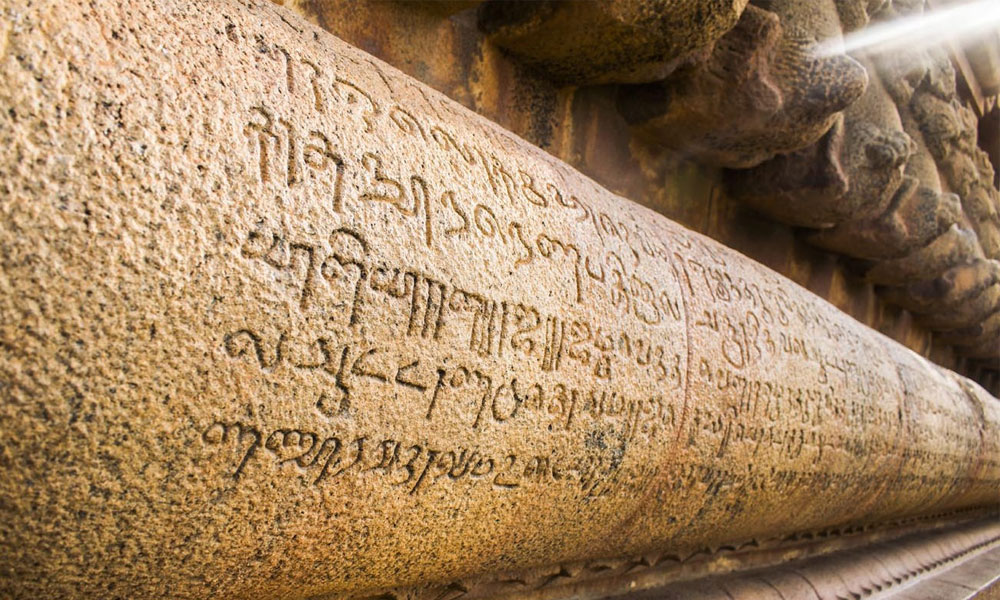
Within thirty kilometres of campus, in the villages around Devanahalli, are hundreds of inscriptions, hero stones, and temples — from the Western Ganga, Hoysala, Vijayanagara, and Mysore periods. Most are weathered, unrecorded, and unknown to the people living next to them. They are not in any guidebook. They are hidden in plain sight.
Over six days, you’ll record one Gram Panchayat — a cluster of about ten villages — and produce a live, public Google map of its heritage sites. The studio is built around five expert-led groups: Inscriptions, Hero Stones, Temples, Mapping, and Interpretation (writing and context). Each group teaches the others. The map cannot be completed without all five.
You won’t visit Devanahalli Fort or Tippu Sultan’s birthplace — those are well-known and well-photographed. The studio takes you to villages where a 9th-century stone might be holding up a tea-shop wall, and where an oral tradition about it might still be alive. There are two field days, with a studio day in between, so you go out, see what you missed, and go out again.
What you’ll make
One shared output, in three forms:
- A live, public Google map of the chosen panchayat — each pin opens a pop-up with photograph, description, period, and why it matters. Built for phones. Anyone with the link can walk to the site.
- Six A2 panels — one from each of the five groups, plus a framing panel. Printed and put up in the studio space on the final day.
- Recording packets — the full backing data (photographs, app records, condition notes, oral history notes), returned to the Mythic Society’s Inscriptions Project collection with your name attached. Your work lives on in a public archive that can be cited.
The Google map stays live and public after the studio ends. The Mythic Society will continue to look after it.
The five groups
| Inscriptions | Stone and copper inscriptions — recording, reading, and dating the period. Led by Gowtham. |
| Hero Stones | Hero stones and memorial stones — the carvings, the panels, dating the period. Led by Anusha. |
| Temples | Standing temples and their inscriptions. Led by Madhusudhan. |
| Mapping | Building the master Google map — structure, pop-up information, mobile experience. Led by Prashant. |
| Interpretation | History of the area, oral history from villagers, landscape photographs, the writer’s voice. Led by P L Udaya Kumar. |
Your six days
| Mon | Framing and roles. Opening Mythic Society’s three Google maps (Inscriptions, Hero Stones, Temples) — these are your syllabus. Groups formed. A short walk to look at real objects. |
| Tue | Tools. Each expert trains their group: photography for stone surfaces, the EpiCollect 5 field-data app, condition notes, ink-rubbings, the Akshara Bhandara tool for comparing letters across periods. Mapping group goes deep on Google My Maps. Interpretation group prepares context for the panchayat. |
| Wed | First field day — all five groups in the panchayat together. Coverage. Things will be missed; that’s the point. |
| Thu | Putting it together. Records cleaned, pop-ups written, the live map takes shape. Mid-afternoon review around the half-built map: what is missing? Day 5 plans firmed up. |
| Fri | Second field day — targeted. Each group goes back with a specific list. Better photographs, missed measurements, follow-up readings, retakes. The map fills in by evening. |
| Sat | Final polish. A2 panels printed. Group presentations to faculty. Public showcase — the map goes live; Gram Panchayat members invited to attend; visitors can open the map on their phones and walk to a site that very afternoon. |
Each day runs 10am–5pm with a midday break. Theory kept to 1–2 hours per day; the rest is hands-on studio or field work.
How you’ll be assessed
| 30% | Quality of the recording — how complete and accurate the field record is. Photographs well-lit and well-framed? App records complete? Condition notes useful? |
| 25% | Depth of the writing — quality of the writing for pop-ups and panels. How well does the text place sites in their history? How clearly does it speak to a general reader? |
| 20% | Teamwork — how well you worked with your group. Did you contribute to the Day 4 review? Did you help your group, or only do your own bit? |
| 25% | Final showcase — the presentation, the panel, and the live map judged together. How clearly you defend your work — visual and writing quality. |
Pass mark is 60%. Group marks are shared, but individual marks within a group can vary based on what the experts have observed of your work.
Who it’s for
20–25 students, in five groups of four to five. Suitable for students from any subject — the studio does not require Kannada-reading skills. A general comfort with smartphones, basic photography, and some field walking is enough.
Students with backgrounds in archaeology, history, architecture, design, geography, or anthropology will be a particularly good fit, but the studio is built to bring in students from other backgrounds productively.
What to bring
A modern smartphone is good enough for the recording proposed (the team will bring two project cameras for use where needed). DSLR or mirrorless cameras welcome but not essential. Comfortable walking shoes for field days.
Your instructor
P L Udaya Kumar & the Mythic Society team
Honorary Director, Bengaluru Inscriptions 3D Digital Conservation Project
This studio is run by The Mythic Society, Bengaluru — a pioneering institution of Indic studies founded in 1909, with a library of around 46,000 volumes and recipient of the Karnataka Rajyotsava Award in 2023. The Society has run scholarly programmes on Karnataka’s heritage for over a century. The five-person team running the studio is from the Society’s Bengaluru Inscriptions 3D Digital Conservation Project.
P L Udaya Kumar is the Honorary Director of the Bengaluru Inscriptions 3D Digital Conservation Project. He holds a Master’s in Engineering Mechanics from IIT Madras, and brings extensive corporate experience from Tata, General Electric, and Schneider Electric. He was recognised as Namma Bengaluru Citizen Individual of the Year (2019) for his work in heritage conservation. The project he leads has so far identified over 100 previously unrecorded inscriptions, more than 1,000 hero stones, and 150 ancient temples in and around Bengaluru. The team uses 3D scanning to create high-resolution digital replicas of weathered inscription stones, and has published findings in the Bengaluru Itihaasa Vaibhava book series.
Joining him on the studio team are Gowtham (Inscriptions), Anusha (Hero Stones), Madhusudhan (Temples), and Prashant (Mapping).

Registration open

Questions about a Studio?
Reach out to the Studios Coordinator. Happy to talk through any of the courses, what to expect day-to-day, or whether a particular Studio fits where you are in your learning right now.
Studios Coordinator
Anand K Sharma
cu.studios@chanakyauniversity.edu.in
+91 88930 33233
Campus
Chanakya University Global Campus
NH-648, Haraluru–Polanahalli
Near Kempegowda Intl. Airport
Devanahalli, Bengaluru — 562165