
Published Date: July 30, 2026
At present, India and ASEAN countries are extensively engaging with each other through trade deals and strategic partnerships. However, the foundation of their friendly relations lies in their centuries-old shared civilizational bond. Initial interactions between India and Southeast Asia began with early maritime journeys between their kingdoms which gradually transformed into well-established trade networks. Along with the trade in commodities, a massive amount of cultural exchange also took place between the two sides. What is even more remarkable is that a few of such cultural traditions and religious practices that were introduced by Indian merchants and missionaries among the local populations in Southeast Asia back then, are prevalent in their societies even today. For instance, famous Hindu deities continue to be worshipped in many Southeast Asian countries, and several of their festivals share similarities with those celebrated in India. The Thai festival, ‘Loi Krathong’, for example, resembles the traditions associated with the Indian festival of Diwali. ‘Loi Krathong’ means ‘float a basket’ and is celebrated by floating lighted floral baskets or ‘krathongs’ on rivers on a full-moon evening around the same time as Diwali in India.
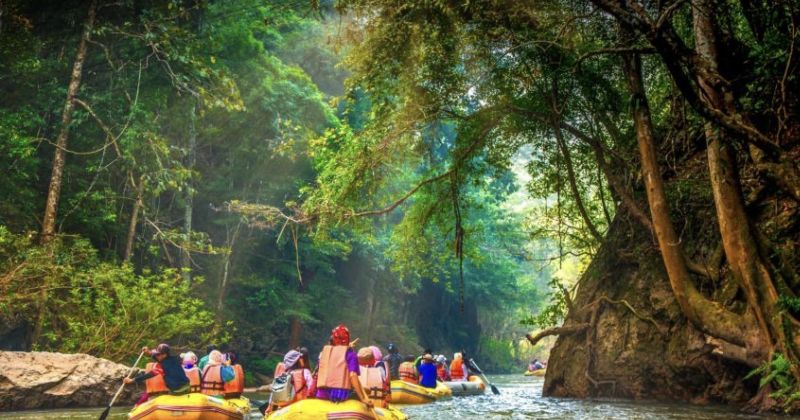
Image Credit: (Visit Southeast Asia)
Furthermore, travellers visiting temples and heritage sites in Southeast Asia today can see a glimpse of India’s civilizational imprint in their architecture, for instance, as reflected in the famous temples of Angkor Wat and Angkor Thom in Cambodia and the magnificent Buddhist temple Borobudur and the Hindu temple Prambanan in Indonesia. In addition to the architectural similarities, the scriptural and literary linkages also continue to resonate in the Southeast Asian societies. Epics like the Ramayana and Mahabharata are still performed through theatre and traditional dance forms across the region, such as the Javanese dances that depict scenes from the Ramayana. The Sanskrit language, too, has left a significant imprint on Southeast Asia and influenced some of the region’s local languages, such as Malay and Bahasa Indonesia, among others, which derive many of their words from Sanskrit. For instance, the Suvarnabhumi Airport in Thailand got its name from the Sanskrit word ‘Suvarnabhumi’, which means ‘Land of Gold’.
Increased India-ASEAN Bilateral Tourism and the Role of the Act East Policy
Today, growing tourism and increased cultural exchanges between Southeast Asia and India are leading to a greater acknowledgement of their shared historical linkages. India and ASEAN’s bilateral tourism has witnessed a remarkable growth over the last few years. According to the India Tourism Data Compendium 2025 approximately 52,35,613 Indians visited different countries in Southeast Asia in 2024, marking a sharp increase of 25.35 percent as compared to 2023 when 41,76,883 Indian nationals travelled to the region. Countries such as Thailand, Singapore, Vietnam, and Malaysia have emerged as some of the most popular destinations for Indian travellers in recent times. For the middle and service classes especially, the region strikes the perfect balance by combining economic affordability and geographical proximity compared to faraway destinations. Therefore, vacationing in cities like Kuala Lumpur, Phuket, Bangkok, Pattaya, Hanoi, Singapore, Ho Chi Minh City, or the widely popular island of Bali has become an easy getaway for Indian travellers, including families, couples, or even solo travellers.
Most of these places in Southeast Asia offer a wide spectrum of attractions, ranging from scenic views, adventure sports, rich heritage and a fascinating cuisine, thereby providing a diverse travel experience. What adds to this is that the region also gives a sense of familiarity and a cultural connection to its Indian visitors and does not project itself as a completely foreign space.
Similarly, there has also been a considerable growth in tourists from Southeast Asian countries visiting India. India welcomed approximately 8,67,210 ASEAN nationals in 2024 compared to 7,64,230 visitors in 2023, indicating an increase of 13.48 percent (India Tourism Data Compendium 2025). Some of the key attractions for ASEAN tourists visiting India include wellness and yoga retreats, and religious pilgrimages to key Buddhist sites such as Sarnath and Bodh Gaya, among others.
However, this gradual increase in bilateral tourism between India and ASEAN, besides rooting in historical connections, is also emerging from recent policy-backed projects and initiatives by both sides. The introduction of simplified visa policies for Indian citizens, such as visa-free entry in Malaysia and Thailand, visa-on-arrival in Indonesia, Cambodia, and Laos and e-visa offered by Vietnam and Singapore, has given a boost to their bilateral relations, resulting in a rise in tourism. Equally important are India’s direct flights facilities to most Southeast Asian countries, including Thailand, Singapore, Indonesia, Malaysia, Vietnam, Cambodia and Myanmar. Such improved air connectivity has made travel easier than before, as the larger goal and focus have been to reduce barriers to international travel.
Further in this context, India’s Act East Policy (AEP) has been another major driver in advancing India’s relations with Southeast Asia and reconnecting their previously stagnant relations. Over the last decade, the smooth conduct of bilateral agreements and diplomatic meetings between ASEAN and India has resulted in their enhanced relations. Additionally, the policy’s focus has been to deepen India-Southeast Asia relations beyond the sphere of traditional diplomacy. In this context, tourism has emerged as a tool of soft power diplomacy and is positively contributing to people-to-people engagement between the two sides.
India’s vision of strengthening its relations with Southeast Asia through its Act East Policy is, therefore, being materialised not only through dialogues and deals but also through increased bilateral tourism. In the present day, tourism has occupied a special place under the AEP as it complements the policy’s vision of the 3Cs- Commerce, Culture and Connectivity and also functions as a potential catalyst in strengthening friendly relations, thereby improving regional stability. A similar vision has also been emphasised in the ASEAN-India Tourism Work Plan for 2023-2027, which identified 17 cooperative activities, including improved connectivity, responsible and sustainable tourism, expanding inter-cultural exchanges, tourism education and training, among others. In recognition of this growing tourism cooperation between the two sides, the year 2025 was announced as the ASEAN-India Year of Tourism.
What more can be done?
Since the inception of the Act East Policy, India has been actively engaged in several programs and initiatives in the cultural sector in Southeast Asia. For instance, Indian institutions such as the Indian Council for Cultural Relations (ICCR) have focused on showcasing India’s and ASEAN’s cultural legacy through exhibitions and film festivals. Furthermore, the Architectural Survey of India (ASI) is presently involved in many heritage restoration projects in the region, such as in the temples of Vat Phau in Laos and Angkor Wat in Cambodia, among others. This indicates that the two sides have actively focused on their shared cultural preservation lately. However, what needs to be focused on next in this domain is that the renewed tourism must be channelled further and be established into a larger framework.
What India can aim for in the second decade of the Act East Policy is to invest more in the development of its tourism sector and enhance its tourist infrastructure to attract more travellers from ASEAN countries, as the focus should be on making their visit to India a memorable one. For instance, the Buddhist circuits, the Ramayana trails and pilgrimage routes are some of the ongoing projects that are appealing to ASEAN tourists visiting India and have been identified as key features of India-Southeast Asia’s shared spiritual connection. It is initiatives like these that have provided a cultural boost between the two sides.
A further boost to India’s tourism sector could come through investments in its Northeastern region (NER). Despite being a gateway to Southeast Asia, the region has remained relatively underexplored, and its potential as a tourist hub is yet to be fully realised. Moreover, a few connectivity projects in the NER, such as the Kaladan Multi-Modal Transit Transport Project and the India-Myanmar-Thailand Trilateral Highway, although they have emerged as steps in the right direction in improving regional connectivity, their delayed completion has highly impacted the vision of enabling greater tourist movement between India and Southeast Asia. Therefore, ensuring the timely completion of these projects will resolve connectivity issues in the region and improve the overall travel experience. Additionally, the Northeast’s potential as a tourism destination can be further explored by investing in B&B’s and hotels and organising music, food and cultural festivals more frequently. This will help not only attract tourists from neighbouring ASEAN countries but also boost the region’s economy and provide employment opportunities for its locals.
Another key area that India must focus on in order to promote tourism is the further easing of its present visa policies for ASEAN citizens. Although India already provides e-visa facilities to all ASEAN countries, our current visa scheme remains comparatively less liberal than that of most Southeast Asian countries. Policymakers must consider addressing this asymmetry as it reflects a gap in the vision and implementation of the Act East Policy. Simplified visa procedures, including considering visa-free entry and visa on arrival for ASEAN citizens, are some of the few suggestions in this context. Such measures will encourage greater tourist inflows from the Southeast Asian countries and further boost our bilateral tourism with the region. Another challenge that needs to be addressed is the difficulty posed by language barriers that is faced by most ASEAN nationals visiting India. To address this problem, the government can train and appoint guides fluent in Southeast Asian languages to assist the ASEAN tourists. Such initiatives and interventions, along with a well-curated tourist itinerary, can significantly enhance the overall experience of ASEAN visitors in India.
Conclusion
In an age shaped by geopolitical competition and regional rivalries, India-Southeast ties have therefore emerged as a strong example of friendly relations in the common neighbourhood. Their present partnership showcases how a realignment along cultural lines and the promotion of closer societal ties can help revive fading relations, whereby the tourism sector has emerged as a potential contributor to enhancing their regional engagement.
Such an increase in India-Southeast Asia bilateral tourism in recent years has led to a greater appreciation of their shared civilisational bonds and, at the same time, has created new avenues for their people to connect even today. Moreover, with the Act East Policy entering its second decade, continued investments in connectivity and developmental projects and the tourist infrastructure will advance India’s and ASEAN’s shared vision of easy travel and also strengthen their partnership across the Indo-Pacific region at large.
About the Author:
Dr. Faareha Usmani is a Non-Resident Fellow at the SCB Chair for IR at Chanakya University. She has previously worked as a Research Intern at the Indian Council of World Affairs. She has completed her PhD from JMI, New Delhi and her research focused on India’s Act East Policy. Her other research interests include India’s Foreign Policy, India’s Maritime Interests, Soft Power, Southeast and East Asia and the Indo-Pacific.