
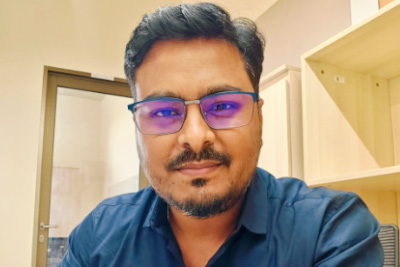
Gourab Mukherjee
Ph.D., IIT GuwahatiAssistant Professor, School of Mathematics and Natural Sciences
Gourab Mukherjee
Ph.D., IIT GuwahatiMy primary research interest lies in exploring the role of metal ions in biology using various spectroscopic and analytical tools. Metalloenzymes in nature play a crucial role in catalyzing a plethora of biological reactions. Taking inspiration from nature, I design small molecular models to emulate the active sites of various metalloenzymes and study their structure-function correlations. In addition, these bio-inspired model systems are employed to catalyse different reactions, including C-H activation, aldehyde deformylation, and other oxidation reactions. I am also interested in designing artificial metalloenzymes by covalently modifying proteins using metal cofactors and using them as biocatalysts towards new-to-nature reactions. Currently, I am working on designing LPMO models to study the degradation of recalcitrant polysaccharides and biomass valorisation.
Dr Gourab Mukherjee is an Assistant Professor in the School of Mathematics and Natural Sciences at Chanakya University. Prior to his current appointment, he served as a DST-INSPIRE Faculty at CSIR–Indian Institute of Chemical Technology (IICT), Hyderabad, and as a MOPGA Visiting Researcher at iSm2-BiosCiences, Institut des Sciences Moléculaires de Marseille, France.
He obtained his Ph.D. in Chemistry from IIT Guwahati and pursued postdoctoral research at the Tata Institute of Fundamental Research (TIFR), Mumbai, and the University of Edinburgh, UK. He also held a Visiting Research Fellowship at the University of Manchester.
Dr Mukherjee’s research lies at the interface of inorganic and bioinorganic chemistry, with a focus on the design and mechanistic investigation of transition metal complexes relevant to biological and catalytic processes. Some of his works have been published in reputed international journals.
- Ph.D., (2019) in Chemistry, IIT Guwahati, Assam, India
- M.Sc., (2014) in Chemistry, Burdwan University, West Bengal, India
- B.Sc., (2012) in Chemistry, Burdwan University, West Bengal, India
[19] G. Mukherjee, P. Panwar, C. V. Sastri, J. K. Satpathy, and S. P. de Visser, “How does tuning of the primary coordination sphere around ferryl-oxo intermediates affect structure and reactivity? Insights into axial and equatorial ligand field effects,” JACS Au, vol. 6, no. 4, p. 2136, 2026, doi: 10.1021/jacsau.6c00037.
[18] D. Bhandary, L. Sahoo, G. Velmurugan, and G. Mukherjee, “Bioinspired Cu(II) complexes with tunable axial donors: Unravelling structure-function correlations in phenoxazinone synthase mimics,” Dalton Trans., vol. 55, p. 2297, 2026, doi: 10.1039/D5DT02500A.
[17] G. Velmurugan, G. Mukherjee, U. K. Bagha, C. V. Sastri, and P. Comba, “Computational and experimental insights into a ferric cumylperoxido species stabilized in a bispidine scaffold,” Z. Anorg. Allg. Chem., vol. 651, Art. no. e202500189, 2025, doi: 10.1002/zaac.202500189.
[16] D. Bhandary, S. P. de Visser, and G. Mukherjee, “Implications of non-native metal substitution in carbonic anhydrase-engineered enzymes and models,” Chem. Commun., vol. 61, p. 612, 2025, doi: 10.1039/D4CC05003G.
[15] G. Mukherjee, G. Velmurugan, M. Kerscher, J. K. Satpathy, C. V. Sastri, and P. Comba, “Mechanistic insights into amphoteric reactivity of an iron-bispidine complex,” Chem. Eur. J., vol. 30, Art. no. e202303127, 2024, doi: 10.1002/chem.202303127.
[14] G. Mukherjee, S. P. de Visser, and C. V. Sastri, “Iron catalyzed C–H amination,” in Handbook of CH-Functionalization, 1st ed., D. Maiti, Ed. Weinheim, Germany: Wiley-VCH GmbH, 2023, ch. F0230, doi: 10.1002/9783527834242.chf0230.
[13] S. P. de Visser, G. Mukherjee, H. S. Ali, and C. V. Sastri, “Local charge distributions, electric dipole moments and local electric fields influence reactivity patterns and guide regioselectivities in α-ketoglutarate-dependent nonheme iron dioxygenases,” Acc. Chem. Res., vol. 55, no. 1, pp. 65, 2022, doi: 10.1021/acs.accounts.1c00538.
[12] U. K. Bagha, J. K. Satpathy, G. Mukherjee, P. Barman, D. Kumar, S. P. de Visser, and C. V. Sastri, “Oxidative dehalogenation of halophenols by high-valent nonheme iron(IV)-oxo intermediates,” Faraday Discuss., vol. 234, pp. 58, 2022, doi: 10.1039/D1FD00064K.
[11] G. Mukherjee, J. K. Satpathy, U. K. Bagha, M. Q. E. Mubarak, C. V. Sastri, and S. P. de Visser, “Inspiration from nature: Influence of engineered ligand scaffolds and auxiliary factors on the reactivity of biomimetic oxidants,” ACS Catal., vol. 11, no. 15, pp. 9761, 2021, doi: 10.1021/acscatal.1c01993.
[10] S. P. de Visser, Y.-T. Lin, H. S. Ali, U. K. Bagha, G. Mukherjee, and C. V. Sastri, “Negative catalysis or non-Bell-Evans-Polanyi reactivity by metalloenzymes: Examples from mononuclear heme and non-heme iron oxygenases,” Coord. Chem. Rev., vol. 439, Art. no. 213914, 2021, doi: 10.1016/j.ccr.2021.213914.
[9] U. K. Bagha, J. K. Satpathy, G. Mukherjee, C. V. Sastri, and S. P. de Visser, “A comprehensive insight into aldehyde deformylation: Mechanistic implications from biology and chemistry,” Org. Biomol. Chem., vol. 19, no. 9, pp. 1879, 2021, doi: 10.1039/D0OB02204G.
[8] N. N. Deshavath, G. Mukherjee, V. V. Goud, V. D. Veeranki, and C. V. Sastri, “Pitfalls in the 3,5-dinitrosalicylic acid DNS assay for the reducing sugars: Interference of furfural and 5-hydroxymethylfurfural,” Int. J. Biol. Macromol., vol. 156, pp. 180, 2020, doi: 10.1016/j.ijbiomac.2020.04.045.
[7] G. Mukherjee and C. V. Sastri, “Eccentricities in spectroscopy and reactivity of non-heme metal intermediates contained in bispidine scaffolds,” Isr. J. Chem., vol. 60, nos. 10–11, pp. 1032, 2020, doi: 10.1002/ijch.202000045.
[6] G. Mukherjee, F. G. Cantú Reinhard, U. K. Bagha, C. V. Sastri, and S. P. de Visser, “Sluggish reactivity by a nonheme iron(IV)-tosylimido complex as compared to its oxo analogue” Dalton Trans., vol. 49, no. 18, pp. 5921, 2020, doi: 10.1039/D0DT00018C.
[5] C. Colomban, A. H. Tombing, G. Mukherjee, C. V. Sastri, A. B. Sorokin, and S. P. de Visser, “Mechanism of oxidative activation of fluorinated aromatic compounds by N-bridged diiron-phthalocyanine: What determines the reactivity?” Chem. Eur. J., vol. 25, no. 63, pp. 14320, 2019, doi: 10.1002/chem.201902934.
[4] G. Mukherjee, A. Alili, P. Barman, D. Kumar, C. V. Sastri, and S. P. de Visser, “Interplay between steric and electronic effects: A joint spectroscopy and computational study of nonheme iron(IV)-oxo complexes” Chem. Eur. J., vol. 25, no. 19, pp. 5086, 2019, doi: 10.1002/chem.201806430.
[3] S. S. Nag, G. Mukherjee, P. Barman, and C. V. Sastri, “Influence of induced steric effects on the switchover reactivity of mononuclear Cu(II)-alkylperoxo complexes” Inorg. Chim. Acta, vol. 485, pp. 80, 2019, doi: 10.1016/j.ica.2018.09.087.
[2] G. Mukherjee, C. W. Z. Lee, S. S. Nag, A. Alili, F. G. Cantú Reinhard, D. Kumar, C. V. Sastri, and S. P. de Visser, “Dramatic rate-enhancement of oxygen atom transfer by an iron(IV)-oxo species by equatorial ligand field perturbations” Dalton Trans., vol. 47, no. 42, pp. 14945, 2018, doi: 10.1039/C8DT02142B.
[1] F. G. Cantú Reinhard, P. Barman, G. Mukherjee, J. Kumar, D. Kumar, C. V. Sastri, and S. P. de Visser, “Keto-enol tautomerism triggers an electrophilic aldehyde deformylation reaction by a nonheme manganese(III)-peroxo complex” J. Am. Chem. Soc., vol. 139, no. 50, pp. 18328, 2017.
Project 1
Title: Sustainable Bio-Catalysis using Artificial Metalloenzymes
Duration: 2023-2028
Granting Agency: Department of Science & Technology (DST), Govt. of India
PIs/Co PIs: Gourab Mukherjee (sole PI)
Purpose: To develop synthetically modified biocatalysts that are able to catalyse organic transformations with selectivity.
Status: Ongoing
Grant Amount: INR 35 lakh
- MOPGA Visiting Research Fellowship (2025) for Early Career Researchers, funded by France’s Ministries of Europe and Foreign Affairs (MEAE) and of Higher Education, Research, and Innovation (MESRI) (2026-2027).
- DST−INSPIRE Faculty Fellowship (2022), funded by the Department of Science & Technology, Govt. of India.
- Marie Sklodowska Curie Seal of Excellence Award by European Commission (2022)
Student Supervision
- 03/2024 – 03/2026
Ms. Dyuti Bhandary (Project Associate at CSIR – Indian Institute of Chemical Technology, India) - 02/2024 – 07/2024
Ms. Prathyusha Kota (M.Sc. Dissertation at CSIR – Indian Institute of Chemical Technology, India)