
A Report on Webinar – India and the West Asia Crisis: Navigating the Geopolitical Challenge
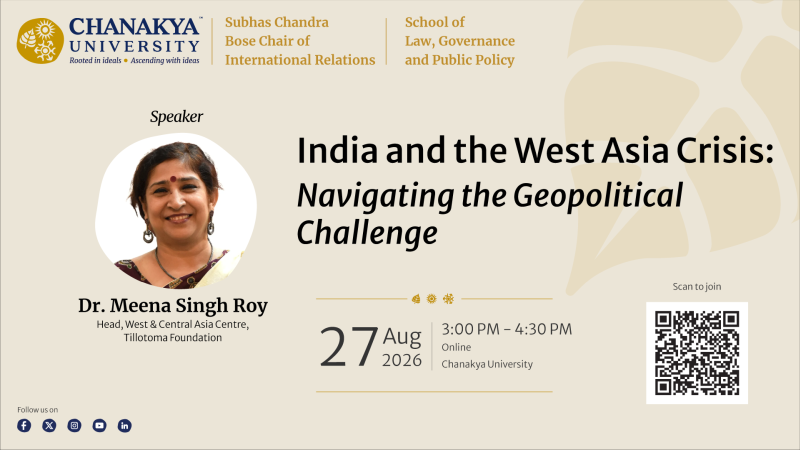
The Subhas Chandra Bose Chair of International Relations (SCB Chair of IR) at Chanakya University, Bengaluru hosted an online talk by Dr. Meena Singh Roy titled ‘India and the West Asia Crisis: Navigating the Geopolitical Challenge’ on August 27, 2026. Dr. Meena Singh Roy is Head, West and Central Asia Centre at the Tillotoma Foundation. The talk and discussions centered around identifying key geopolitical challenges, regional security shifts, and connectivity projects that influence India’s strategic and economic partnerships in West Asia. It was attended by students, scholars from different institutions, research interns and faculty from the SCB Chair of IR.
While giving his welcome remarks, Prof. Chetan Singai, Dean, School of Law, Governance and Public Policy, Chanakya University, mentioned about the confusing set of perspectives coming from media on West Asian crisis, pointing out the cultural hegemony inherent in terminology that privileges the term “Middle East” over “West Asia”. He noted that this session was the third of its kind in a seminar series focused on the region, following a first seminar on individual experiences in West Asia and a second on the historical ties and shared legacy between India and West Asia.
Dr. Meena Singh Roy began her talk by remarking that West Asia has never been a stable region and that even the more stable part of the region, the Gulf, is not as stable as it was believed to be. She noted that West Asia “is like a web – the more you dig, the more you get entangled,” adding that the deluge of information about the region is itself a problem, with even objectively regarded sources like Al Jazeera now viewed as partisan. Dr. Roy introduced the framework of ‘Greater West Asia’ which expands the traditional lens of ‘West Asia and North Africa’ (WANA) and also includes Eurasia. She highlighted that the region’s geographical position as the meeting point of three great faiths such as Islam, Christianity, and Judaism, being coupled with its vast resources, has historically invited external interventions, creating a state of perpetual instability.
Dr. Roy pointed to the highly fractured and divided state of contemporary global politics as a primary driver of uncertainty. Alongside growing great power competition among the US, China, Russia, and Iran, she noted that the return of President Donld Trump introduces a new wave of uncertainty. Concurrently, a new economic paradigm is emerging through South-South cooperation, exemplified by the expansion of BRICS, the SCO, and the I2U2. Key connectivity and infrastructure projects, such as the Belt and Road Initiative, the International North-South Transport Corridor, and the India-Middle East-Europe Economic Corridor (IMEC), are moving at their own pace, alongside an escalating struggle to acquire advanced civilian and military technologies, including artificial intelligence.
At the regional level, Dr. Roy observed a period of significant overlapping wars, including the Russia-Ukraine war, conflicts in Sudan, Libya, Yemen, and the regime change in Syria. She identified October 7, 2023 as a critical turning point for Israel, which has shifted its national security discourse towards military deterrence against Iran, Syria, and Lebanon. Analysing Israel’s four pillars of national security – deter, defend, alert, and defeat, she suggested that Israel failed on the first three and is now focusing on the fourth pillar to ensure a decisive defeat of its adversaries. This military campaign is reshaping the regional landscape, replacing the Shia axis (with the demise of Hezbollah and Hamas) with a Sunni axis. She also spoke about multiple narratives which are emanating about the region including the intent of Israel to secure its interests by creating a Greater Israel.
She further noted that regional reactions reveal a palpable tension; while the general public supports the Palestinian cause, regional governments prioritise maximising the benefits of their interactions with Israel. The formal normalisation process, including the future of the Abraham Accords with the UAE, Bahrain, and Morocco, has been put on hold or rather delayed, and Saudi Arabia’s stance remains in doubt until a ceasefire is reached and progress is made toward a two-state solution. Despite these diplomatic strains, deep economic dependencies persist, as Egypt and Jordan remain heavily reliant on Israel for energy, sourcing approximately 16 percent and 95 percent of their gas from Israel respectively.
On the Palestinian issue, Dr. Roy remarked that near-term prospects are grim. She saw little hope for progress given Israel’s new plans for Gaza, continued US backing, and limited room for internal political shifts in Israeli politics. While the international community could theoretically apply collective pressure on Israel, such as European sanctions on Israel or the termination of diplomatic relations; she argued that these measures are unlikely to be effective unless the pressure originates from the United States. It also needs to be factored into account that Israel’s high-tech and defense capabilities continue to be utilised by both European powers and the US.
Turning to India’s strategic engagement, Dr. Roy outlined the paradigm shift in India’s regional foreign policy from “Look West” to “Think West” and now to “Link West” through enhanced security and economic cooperation. This “Act West” dynamism has gathered momentum with increased high-level visits between Heads of State and senior officials. India’s growing interest is rooted in core economic and strategic priorities: promoting bilateral trade and investment, securing energy security, safeguarding the welfare and remittances of its massive diaspora, and integrating with regional infrastructure plans.
In terms of connectivity, Dr. Roy elaborated on the India-Middle East-Europe Economic Corridor (IMEC), highlighting the UAE’s critical role as India’s primary port of entry. She cited the February 2024 Inter-Governmental Framework Agreement and subsequent agreements on logistics and digital ecosystems as the first tangible milestones since the corridor’s G20 launch. After slow progress in 2023–24, momentum increased in 2025 with the first meeting of IMEC special envoys in New Delhi on August 05-06, 2025, where the Italian envoy underscored the digital dimension of the corridor through the Blue Raman submarine cable project connecting Mumbai to Genoa.
To sustain and expand cooperation, Dr. Roy urged India to diversify its partnership with West Asian nations, especially Oman, Kuwait, Qatar, Bahrain, Morocco, Jordan, and Egypt into emerging areas such as IT services, cultural and educational cooperation, disaster management diplomacy, climate change, food and water security, space and cyber cooperation, defence and counter-terrorism cooperation, maritime security, infrastructure, agriculture, health diplomacy, preparedness for pandemics, and education and banking.
The talk was followed by interesting discussions on the following themes:
- The geopolitical impact of President Trump’s return on West Asia’s stability and the US-Iran-Russia dynamic.
- The future viability of the Abraham Accords and the normalisation process under current regional conflicts.
- Structural energy dependencies in the region
- The strategic significance of trans-regional corridors like IMEC and the integration of digital connectivity.
- India’s multi-vector foreign policy approach in balancing relations with competing regional and global actors.
The webinar presented interesting research pointers for the SCB Chair’s IR activities in the domain of engagement with West Asia. Specifically, it validates the suggestion for strengthening a purposeful multi-vector policy, minimising overdependence on any single power, exploring the digital and physical linkages of trans-regional connectivity projects like IMEC, and deepening bilateral security and economic partnerships with key regional players based on trust and mutual interests.
(The report was prepared by Mr. Cris Fernando Anand Perez, Research Intern at the Subhas Chandra Bose Chair of International Relations, Chanakya University, Bengaluru)