
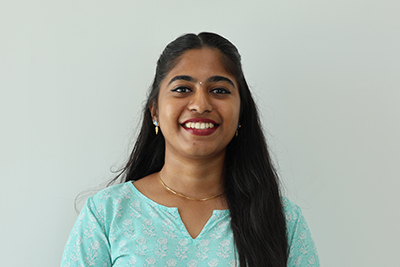
Gargi L. Shanbhag
M.A., Manipal UniversityGargi L. Shanbhag
M.A., Manipal UniversityMy research journey is anchored in the conviction that India’s story in the twenty-first century cannot be understood—or shaped—without a deep, multidimensional engagement with its strategic environment. At the Subhas Chandra Bose Chair on International Relations, my work spans a spectrum of interlinked domains: Indo-Pacific geopolitics, religious terrorism and extremism, India’s national security, and defence and military modernization. I am equally committed to advancing non-Eurocentric approaches to International Relations theory, grounding my analysis in India’s civilisational ethos while engaging critically with global debates.
One of my core areas of inquiry is India’s foreign policy and worldview, particularly as it navigates the shifting balance of power in the Indo-Pacific. My research on religious extremism interrogates its evolving manifestations and implications for regional stability. I also examine India’s defence posture—its modernization imperatives, indigenous capacity-building, and the strategic trade-offs that define its security choices.
My intellectual foundations are enriched by my engagement with classical Indian political thought. Projects exploring the Arthashastra, Mahabharata, Ramayana, and Thirukkural have allowed me to bridge ancient strategic wisdom with contemporary policy challenges, revealing enduring principles of statecraft, diplomacy, and conflict management.
Through my publications, I have sought to apply this integrative lens to pressing issues. My special report, India’s Withdrawal from RCEP: A Vantage for China in the Region, analysed the geopolitical and economic consequences of New Delhi’s decision to opt out of the trade pact, particularly its implications for China’s influence in the Indo-Pacific. My article, Geopolitics of Intellectual Property Rights: Implications for India’s National Security, explored how global IPR regimes intersect with questions of technological sovereignty, defence innovation, and strategic autonomy.
I have also collaborated on work examining India–US relations under Trump 2.0, including the evolving contours of this partnership in a changing global order. Across these projects, my objective has been to illuminate how India can safeguard its interests while contributing constructively to global governance.
Ultimately, my research quest is about more than analysing strategy—it is about reconstructing the frameworks through which we understand India’s place in the world. By marrying contemporary geopolitical analysis with India’s intellectual foundations, I aim to contribute to a strategic discourse that is both globally relevant and deeply rooted in Indian strategic thought and theory.
Gargi Shanbhag is a research assistant at Chanakya University’s Subhas Chandra Bose Chair on International Relations, under the School of Law, Governance and Public Policy since June 2024. She is interested in non-western perspectives to international relations, India’s strategic thought and culture, defence, military indigenisation and modernization, and religious terrorism.
She has published work on religious extremism, geopolitics of Indo-Pacific in Firstpost, The Sunday Guardian, The Diplomatist etc, and her articles on topics such as India-EU relations, India’s defence indigenization efforts, etc have appeared in MP-IDSA’s Journal of Defence Studies.
- MA in Geopolitics and International Relations, 2022, Department of Geopolitics and International Relations, Manipal Academy of Higher Education, Udupi, Karnataka.
- B.VOC in Journalism, 2020, School of Vocational Education, Tata Institute of Social Sciences, Mumbai, Maharashtra.
- G. Shanbhag, “Geopolitics of the Intellectual Property Rights: Implications for India’s National Security,” Journal of Defence Studies, vol. 18, no. 4, pp. 179–197, Oct.–Dec. 2024.
- G. Shanbhag, “An Assessment of the E3’s Perception of India as a Great Power,” in Reimagining India: In the Geopolitics of the 21st Century, N. Kishor and P. Vaidyaraj, Eds. Karnataka: Vishwa Samvada Kendra, 2023, pp. 3–18.
Popular Writings
- G. Shanbhag, “Bangladesh at Crossroads: The Rise of Political Islam,” Usanas Foundation, Aug. 29, 2024. Available: https://usanasfoundation.com/bangladesh-at-crossroads-the-rise-of-political-islam.
- G. Shanbhag and A. Kumar, “Rising terror attacks in Jammu signal new threats,” Firstpost, Jul. 18, 2024. Available: https://www.firstpost.com/opinion/rising-terror-attacks-in-jammu-signal-new-threats-13793822.html.
- G. Shanbhag, “Russia’s pivot to South China Sea: Decoding Putin’s North Korea, Vietnam visits,” Firstpost, Jun. 24, 2024. Available: https://www.firstpost.com/opinion/russias-pivot-to-south-china-sea-decoding-putins-north-korea-vietnam-visits-13785421.html.
- G. Shanbhag, “India-China Perception Game: Ancient Wisdom in Modern Conflict,” CeSCube, May 9, 2024. Available: https://cescube.com/vp-india-china-perception-game-ancient-wisdom-in-modern-conflict.
- G. Shanbhag, “The butterfly effect: How India’s defence indigenisation impacts global geo-political dynamics,” Firstpost, Dec. 23, 2023. Available: https://www.firstpost.com/opinion/the-butterfly-effect-how-indias-defence-indigenisation-impacts-global-geo-political-dynamics-13538762.html.
- G. Shanbhag, “Rise of religious extremism in West: Should Europe finally bid farewell to secularism?” Firstpost, Jul. 30, 2023. Available: https://www.firstpost.com/opinion/rise-of-religious-extremism-in-the-west-should-europe-finally-bid-farewell-to-secularism-12935302.html.
- G. Shanbhag, “India’s stance at UN welcome, but crucial to start from home,” The Diplomatist, Feb. 3, 2022. Available: https://diplomatist.com/2022/02/03/indias-stance-at-un-welcome-but-crucial-to-start-from-home/.
- G. Shanbhag, “Kin Terrorism – Islamic State’s Recruitment Game Plan in India,” Chanakya Forum, Sept. 6, 2021. Available: https://chanakyaforum.com/kin-terrorism-islamic-states-recruitment-game-plan-in-india/.
Project 1:
- Title: Political Concepts of Arthashastra, Mahabharata and Ramayana
- Duration: January 2022 to June 2025
- Granting Agency: IKS Division of MoE
- PIs/Co PIs: Dr Vinayak Rajat Bhat (PI)
Dr Charu Ratna Dubey (Co-PI)
Sri Saurav Sarmah (Co-PI) - Purpose: A robust challenge to Western domination of political philosophy by providing an Indian alternative perspective.The promotion of an indigenous Indian political discourse by the publication of a book on Political Concepts in Ancient Indian Literature and papers on the subject, along with the design of a choice-based credit course on Indian Political Philosophy.
- Short Description: This project tried to bridge the gap by looking at ancient Indian texts considering the modern classification of political philosophy. Specifically, it identified and analysed political concepts – sovereignty, kingship, welfare, market, diplomacy and war in three important texts – Ramayana, Mahabharata and Arthashastra. Then, it classified these ideas into four ideological categories, viz., realism, liberalism, conservatism and socialism and attempt to conceptualise the ideological orientation of ancient Indian political philosophy.
- Status: Closed
Linkedin: https://www.linkedin.com/in/gargi-shanbhag-a7ab68166/
Twitter (X): @gargispeaks