
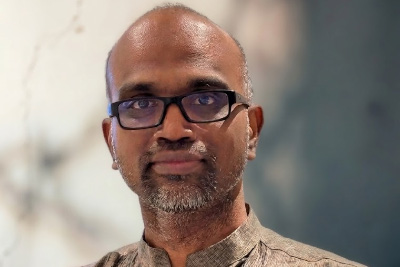
Aswin Kumar Balasubramanian
Ph.D., University of Texas AustinAswin Kumar Balasubramanian
Ph.D., University of Texas Austin
aswin.b@chanakyauniversity.edu.in
Mathematical Physics, Quantum Field Theories, Representation Theory, Machine Learning
My research transcends traditional subject boundaries and involves intersections between Theoretical Physics, Mathematics, and Machine Learning. I enjoy developing new connections between these subjects, and my work has yielded new physical and mathematical insights.
A large part of my research has been at the intersection of Supersymmetric Quantum Field Theories (idealized versions of the Quantum Field Theory describing our real world) and the mathematics of Complex Integrable Systems, like the Hitchin Integrable System. In a joint project with J. Distler and R. Donagi, we initiated the study of the Hitchin Integrable System as a family over the Deligne-Mumford moduli space of curves, proving some new mathematical results about the Hitchin Base (as a global family) and its degeneration in the nodal limit. In this work, we also proposed a conjectural solution to the Deligne-Simpson problem that involves the “OK condition”—a condition whose origins are in the study of certain monopole operators in the associated Supersymmetric Field Theories. This suggests a new approach to solving a fundamental mathematical problem.
In earlier work with J. Distler, we outlined how the theory of sheets (a beautiful part of the theory of complex semisimple Lie algebras) offers the natural language to describe the mass-deformed versions of a large class of Superconformal Field Theories. In the Wilsonian sense, studying the conformal theories together with their mass deformations is an important part of understanding the larger world of N=2 theories. For SU(2) N=2 theories, this program was carried out in detail by Seiberg and Witten in the 1990s, and our work can be taken as a starting point for a similar study of this larger class of theories.
In collaboration with J. Teschner, I developed an alternate approach to connect the Geometric Langlands Program, Supersymmetric Field Theories, and 2D Conformal Field Theories using the Alday-Gaiotto-Tachikawa correspondence.
More recently, I have developed an interest in the theory of machine learning, with ongoing projects devoted to understanding it using various tools from mathematics and physics.
Aswin Kumar Balasubramanian has taught at Chanakya University’s School of Mathematics and Natural Sciences since 2026.
He obtained his PhD in Physics from University of Texas Austin where he was a student of the Theory Group. Before that, he obtained his B. Tech in Aerospace Engineering (with a minor in Physics) from IIT Madras.
He has held postdoctoral appointments at DESY (Hamburg), Department of Mathematics (University of Hamburg), New High Energy Theory Center and Dept of Physics & Astronomy (Rutgers University) and was a visiting research fellow at ICTS (Bengaluru).
- Ph.D., (Physics) from University of Texas Austin
- B.Tech., (Aerospace) from IIT Madras
- “Families of Hitchin Systems and N=2 Theories”, Advances in Theoretical and Mathematical Physics 26 (2022) 6, 1585-1667 by Aswin Balasubramanian, Jacques Distler and Ron Donagi
- “Supersymmetric Field Theories and Geometric Langlands: The Other Side of the Coin”, Proceedings in Symposia of Pure Mathematics 98 (2018) 79-106 (Proceedings of String-Math 2016) by Aswin Balasubramanian and Joerg Teschner
- “Masses, Sheets and Rigid SCFTs”, Advances in Theoretical and Mathematical Physics 25 (2021) 8, 1953-2054 by Aswin Balasubramanian and Jacques Distler
- “The Hitchin Image in Type-D”, Annales Henri Poincare 27 (2025) 5, 1563-1605 by Aswin Balasubramanian, Jacques Distler, Ron Donagi and Carlos Perez-Pardavila
- Simons and Infosys Visiting Research Fellowships at ICTS Bengaluru
- I was one of the organizers of a sequence of meetings at the intersection of Quantum Field Theories and Geometric Representation Theory: QFT-GRT 2018 and QFT-GRT 2021 at ICTS-Bengaluru. The second meeting also included a special event to honor mathematicians M.S. Narasimhan and C.S. Seshadri.
- The goal of these meetings was to bring together scientists working on (or with an interest in) these intersectional topics and to initiate and energize new collaborations between them, especially involving those working in Indian academia.